


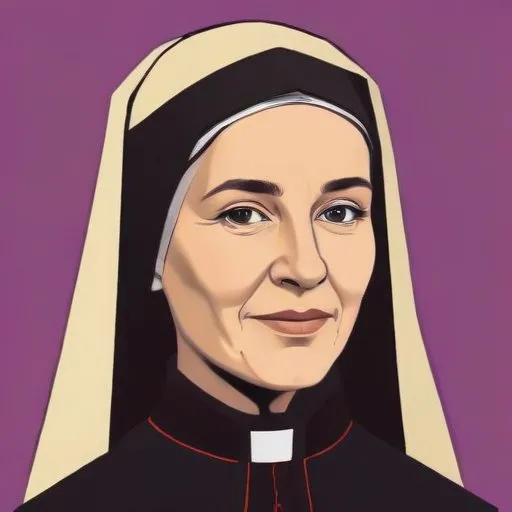
A French-Canadian nun who founded a congregation in Montreal, dedicated to educating and caring for the poor and marginalized, leaving a lasting legacy in Canadian history.
Marguerite Bourgeoys is renowned for establishing the Congregation of Notre Dame of Montreal, one of the first uncloistered religious communities in the Catholic Church. This visionary sister played a pivotal role in shaping the education system in New France, now part of Quebec, Canada, by founding a convent that provided education to young girls, the poor, and children of First Nations.
Born on April 17, 1620, in Troyes, France, Marguerite was the sixth of twelve children to Abraham Bourgeoys and Guillemette Garnier. As a young girl, she showed little interest in joining the convent attached to the monastery in her hometown, where the canonesses were dedicated to the education of the poor but remained cloistered. Instead, she was drawn to the sodality, a group of laywomen who educated young girls outside the cloister.
In 1652, Paul de Chomedey, Sieur de Maisonneuve, the Governor of Montreal, visited his sister, an Augustinian canoness in Troyes, and met Marguerite. Recognizing her passion for education and her experience with the sodality, he invited her to join him in New France to establish a convent that would provide education to the young girls and women of the colony.
Marguerite arrived in Montreal in 1653 and began to develop the convent, which would become the Congregation of Notre Dame of Montreal. She established a community of sisters who were dedicated to education, but unlike traditional convents, they did not remain cloistered. Instead, they interacted with the community, teaching and serving the poor, the sick, and the marginalized.
The Congregation of Notre Dame focused on providing education to young girls, the poor, and children of First Nations. Marguerite and her sisters also ministered to the sick, the elderly, and the poor, establishing a hospital and an orphanage. Her innovative approach to education and service earned her recognition as a pioneer in the field of education.
Marguerite Bourgeoys was declared venerable by the Pope in 1878 and canonized in 1982, becoming the first female saint of Canada. Her legacy continues to inspire generations, and her congregation remains a testament to her innovative approach to education and service.
Marguerite Bourgeoys' legacy extends beyond the Catholic Church, inspiring generations to recognize the importance of education, service, and community engagement. Her innovative approach to religious life has paved the way for modern religious communities to engage with the world in meaningful ways.
"The love of God is not something to be kept for oneself, but something to be shared with others."
Marguerite Bourgeoys' remarkable story continues to inspire and motivate people around the world, serving as a testament to the power of education, service, and community engagement.
Born in 1651
Founded the Institute of the Brothers of the Christian Schools, a Catholic religious teaching congregation, and is considered the patron saint of teachers, known for his innovative and compassionate approach to education.
Born in 1581
A 17th-century French priest dedicated his life to serving the poor and marginalized, establishing a congregation of priests and nuns to provide aid and comfort to those in need. He's revered for his selfless charity and compassion.
