


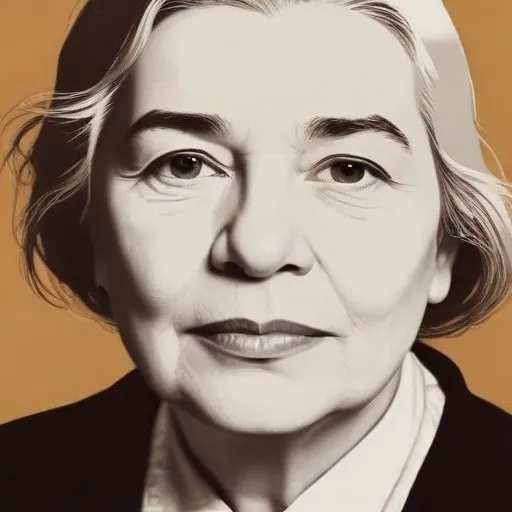
A Belgian-French author and poet, known for her lyrical and introspective works that explore themes of love, history, and the human condition, with a unique blend of classicism and modernity.
Marguerite Yourcenar, a Belgian-born French novelist and essayist, is renowned for her profound contribution to 20th-century literature, earning her a place among the most esteemed writers of her time. Her works, marked by historical depth, philosophical insight, and lyrical prose, have captivated readers worldwide.
Born Marguerite Antoinette Jeanne Marie Ghislaine Cleenewerck de Crayencour on June 8, 1903, in Brussels, Belgium, Yourcenar's life was shaped by her aristocratic heritage and the tragic loss of her mother ten days after her birth. Raised by her paternal grandmother, she adopted the surname Yourcenar as her pen name in 1947, later taking it as her legal surname.
Yourcenar's literary journey began with the publication of her first novel, Alexis, in 1929. Her subsequent works, including Coup de Grâce (1939) and Le Coup de Grâce (1939), showcased her mastery of language and narrative structure. Her translation of Virginia Woolf's The Waves (1937) further established her reputation as a scholar of literature.
In 1951, Yourcenar published Memoirs of Hadrian, a novel that would become her magnum opus. This historical fiction masterpiece, which she had been writing on and off for a decade, tells the story of the Roman Emperor Hadrian's life and reign. The novel's immediate success solidified Yourcenar's position as a leading literary figure.
Yourcenar's literary accomplishments earned her numerous accolades, including the Prix Femina (1952) and the Erasmus Prize (1963). In 1965, she was nominated for the Nobel Prize in Literature. In 1980, she became the first woman elected to the Académie Française, France's highest literary institution.
Yourcenar's personal life was marked by significant relationships. She formed a lifelong connection with literary scholar Grace Frick, whom she met in 1937. The couple's partnership lasted until Frick's death in 1979. Yourcenar's later companion, Jerry Wilson, died of AIDS in 1986.
Yourcenar's literary legacy extends beyond her own works. She has inspired generations of writers, philosophers, and scholars. Her philosophical contributions, particularly in the realm of existentialism, continue to resonate with readers and scholars alike. Her influence on modern society is evident in the numerous translations of her works and the enduring relevance of her themes and ideas.
"The story of a life is not a series of events, but an accumulation of whispers, rumors, and echoes of the past."
"In the depth of winter, I finally learned that within me there lay an invincible summer."
Yourcenar's life spanned a tumultuous period in world history, marked by two World Wars and significant social and cultural changes. Her writings provide a unique perspective on these events, offering insights into the human experience during times of turmoil. Her legacy continues to inspire new generations of writers, thinkers, and scholars.
Yourcenar's works are often compared to those of her contemporaries, including Jean-Paul Sartre and Albert Camus. While sharing similarities with these thinkers, Yourcenar's unique perspective and literary style set her apart from her peers.
Yourcenar's relationships, both personal and professional, were marked by a deep sense of loyalty and dedication. Her partnership with Grace Frick, in particular, remains an inspiration to many, serving as a testament to the enduring power of love and companionship.
Yourcenar's influence extends beyond the literary realm, with her works inspiring numerous adaptations in film, theater, and music. Her unique blend of historical depth and philosophical insight has captivated audiences worldwide, cementing her status as a cultural icon.
Born in 1889
A renowned French creative force, celebrated for his innovative and surreal works that blurred the lines between literature, art, and cinema, leaving an indelible mark on 20th-century culture.
Born in 1869
A French literary giant, renowned for his novels and essays that explored the human condition, morality, and the search for authenticity. His works often blurred the lines between fiction and autobiography.
Born in 1905
Existentialist philosopher and playwright who argued that humans have complete freedom to choose their actions and create their own meaning in life, influencing modern thought on morality and individual responsibility.
Born in 1908
A pioneering feminist philosopher who wrote extensively on ethics, politics, and gender, famously arguing that "one is not born, but rather becomes, a woman."
Born in 1913
A French novelist, philosopher, and journalist who wrote influential works like "The Stranger" and "The Plague", exploring absurdism and the human condition.
Born in 1885
A French literary giant, celebrated for his novels and plays that probed the human condition, morality, and the complexities of faith. His works are known for their psychological depth and lyrical prose.
Born in 1897
A leading figure of the French Resistance during WWII, he wrote influential poetry and novels that explored the human condition, blending politics and art.
Born in 1871
A French poet and philosopher who explored the human condition through lyrical poetry and philosophical essays, delving into the mysteries of existence and the human experience.
