


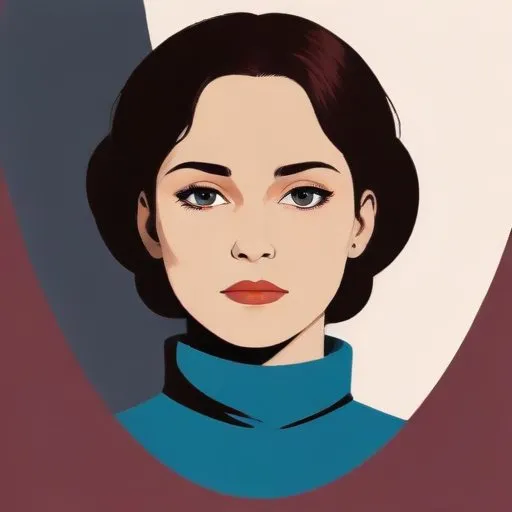
A renowned Russian stage and film actress, celebrated for her iconic performances in Soviet cinema, particularly in the 1930s-1950s.
Maria Ivanovna Babanova, a renowned Soviet and Russian actress, is widely regarded as Vsevolod Meyerhold's greatest actress and was honored with the title of People's Artist of the USSR in 1954. Her remarkable career spanned over six decades, leaving an indelible mark on the world of theater and cinema.
Babanova made her debut in Theodore Komisarjevsky's theatre in 1919, and a year later, she joined Vsevolod Meyerhold's acting courses. Her talent and dedication quickly earned her recognition, and she became an integral part of Meyerhold's troupe.
Babanova's breathtaking performance in Meyerhold's production of "The Magnanimous Cuckold" in 1922 catapulted her to stardom. Alongside Igor Ilyinsky and Vasily Zaichikov, she formed the iconic trio known as IlBaZai, mesmerizing the Moscow public with their harmony and talent.
Babanova's artistic approach was deeply rooted in Meyerhold's principles of biomechanics, which emphasized the actor's physicality and emotional expression. Her commitment to this philosophy enabled her to create characters that were both authentic and captivating.
In 1954, Babanova was bestowed the prestigious title of People's Artist of the USSR, recognizing her immense contributions to the Soviet theatre and cinema.
Babanova's success was not without its challenges. Her supposed rivalry with Zinaida Reich, Meyerhold's wife, led to her departure from Meyerhold's troupe in 1927. Despite this setback, Babanova continued to excel at the Mayakovsky Theatre, where she excelled in roles portraying children and adolescents.
Maria Babanova's remarkable career has inspired generations of actors and artists. Her dedication to her craft and her unwavering commitment to the principles of biomechanics have left an indelible mark on the world of theatre and cinema.
Born in 1863
Developed the "System," a groundbreaking approach to acting that emphasizes emotional recall and authenticity, revolutionizing the art of performance. His techniques remain influential in theater and film to this day.
Born in 1858
A Russian theatre pioneer who co-founded the Moscow Art Theatre and developed the "system" of acting, emphasizing emotional authenticity and psychological realism. He's known for his collaborations with Anton Chekhov and Konstantin Stanislavski.
Born in 1875
A Russian journalist and politician who served as the Soviet Union's first Commissar of Enlightenment, responsible for education and culture, and was a key figure in the development of Soviet arts and literature.
Born in 1898
A pioneer of montage editing, he revolutionized filmmaking with his iconic scenes and theories, influencing generations of directors.
94 Years Old
A visionary filmmaker who explored the human condition through poetic, visually stunning, and introspective movies that continue to inspire artists and audiences alike.
97 Years Old
Russian actor, director, and screenwriter renowned for his iconic roles in Soviet cinema, particularly in the 1960s and 1970s, earning him a legendary status in Russian film history.
