


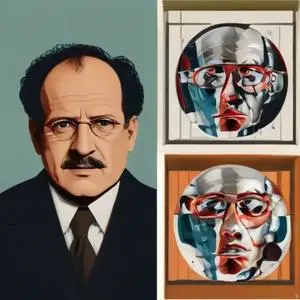
A pioneer of montage editing, he revolutionized filmmaking with his iconic scenes and theories, influencing generations of directors.
Sergei Eisenstein is a legendary figure in the world of cinema, renowned for his pioneering work in film theory and practice, particularly in the art of montage editing. His groundbreaking films, such as Strike, Battleship Potemkin, and October, continue to inspire and influence filmmakers to this day.
Born on January 22, 1898, in Riga, Latvia, to a middle-class family, Eisenstein's early life was marked by frequent moves, a trait that would continue throughout his life. His father, Mikhail Osipovich Eisenstein, was a Jewish architect who had converted to the Russian Orthodox Church, while his mother, Julia Ivanovna Konetskaya, came from a Russian Orthodox family.
Eisenstein's interest in art and architecture was evident from an early age, and he went on to study architecture and engineering at the Petrograd Institute of Civil Engineering. However, his education was interrupted when he left school to join the Red Army in 1918, during the Russian Civil War.
Eisenstein's entry into the world of cinema was serendipitous, as he began working as a set designer and then an assistant director. His breakthrough film, Strike, released in 1925, showcased his innovative montage techniques and launched his career as a filmmaker. This was followed by Battleship Potemkin, also released in 1925, which cemented his reputation as a master of montage editing.
Eisenstein's work was deeply rooted in Marxist ideology, and he believed that film had the power to shape public opinion and influence social change. His theories on montage editing, outlined in his book Film Form, emphasized the importance of juxtaposing images to create a new meaning, rather than simply recording reality.
Eisenstein's influence on modern cinema is immeasurable, with many filmmakers, including Martin Scorsese and Francis Ford Coppola, citing him as a major influence. His theories on montage editing have also influenced other art forms, such as music and literature.
Sergei Eisenstein's legacy extends far beyond his own films, with his pioneering work in montage editing and film theory continuing to inspire new generations of filmmakers. His contributions to the world of cinema have earned him a place among the greatest filmmakers of all time, and his influence will be felt for years to come.
In conclusion, Sergei Eisenstein's groundbreaking work in film theory and practice has left an indelible mark on the world of cinema. His innovative techniques, philosophical contributions, and inspiring legacy continue to shape the course of filmmaking, making him one of the most important figures in the history of cinema.
Born in 1896
A pioneering filmmaker who experimented with documentary and narrative styles, known for his innovative and influential works that pushed the boundaries of cinematic storytelling.
94 Years Old
A visionary filmmaker who explored the human condition through poetic, visually stunning, and introspective movies that continue to inspire artists and audiences alike.
Born in 1858
A Russian theatre pioneer who co-founded the Moscow Art Theatre and developed the "system" of acting, emphasizing emotional authenticity and psychological realism. He's known for his collaborations with Anton Chekhov and Konstantin Stanislavski.
