


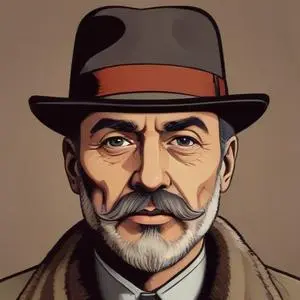
A pioneering filmmaker who experimented with documentary and narrative styles, known for his innovative and influential works that pushed the boundaries of cinematic storytelling.
Dziga Vertov, born David Abelevich Kaufman, was a Soviet pioneer documentary film and newsreel director, as well as a cinema theorist. He is best known for his filming practices and theories, which influenced the cinéma vérité style of documentary moviemaking and the Dziga Vertov Group, a radical filmmaking cooperative active from 1968 to 1972.
Vertov was born on January 2, 1896 (O.S. December 21, 1895), in Białystok, Poland, then part of the Russian Empire. He studied music at the Białystok Conservatory until his family fled from the invading German Army to Moscow in 1915. The Kaufmans soon settled in Petrograd, where Vertov began writing poetry, science fiction, and satire.
Vertov adopted the name Dziga Vertov, which loosely translates from Ukrainian as "spinning top," during his studies in medicine at the Psychoneurological Institute in Saint Petersburg in 1916-1917. It was during this time that he began experimenting with sound collages, laying the foundation for his future work in film.
Vertov is known for his early writings, mainly unpublished, which focused on the individual versus the perceptive nature of the camera lens, which he called his "second eye." His theories on film and filmmaking were ahead of his time, and his concept of "film-truth" revolutionized the way people approached documentary filmmaking.
Vertov's most famous work is the 1929 film "Man with a Movie Camera," which was voted the eighth-greatest film ever made in the 2012 Sight & Sound poll. The film is a city symphony that explores the daily life of Moscow, Kiev, and Odessa, featuring innovative cinematography and editing techniques.
Vertov's influence can be seen in many filmmakers, including Jean-Luc Godard, François Truffaut, and Stanley Kubrick. His theories on film and filmmaking continue to inspire filmmakers and scholars today. The Dziga Vertov Group, a radical filmmaking cooperative, was named after him and active from 1968 to 1972.
Vertov was married to Yelizaveta Svilova, who was also a filmmaker and worked with him on many projects. His younger brothers, Boris Kaufman and Mikhail Kaufman, were also noted filmmakers.
Vertov's work has been recognized and celebrated throughout his career, including being voted one of the greatest filmmakers of all time in various polls and retrospectives.
Vertov believed that film should be used to capture reality, rather than staged or scripted scenes. He saw film as a way to document life and reveal the truth, rather than to entertain or manipulate audiences.
Through his work and theories, Vertov left an indelible mark on the world of documentary filmmaking, inspiring generations of filmmakers to come.
Born in 1898
A pioneer of montage editing, he revolutionized filmmaking with his iconic scenes and theories, influencing generations of directors.
94 Years Old
A visionary filmmaker who explored the human condition through poetic, visually stunning, and introspective movies that continue to inspire artists and audiences alike.
Born in 1894
A pioneering filmmaker of Ukrainian origin, known for his poetic and visually stunning movies that often explored the human condition, particularly in the context of Soviet Ukraine.
