


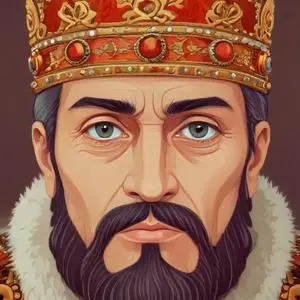
The first Tsar of Russia, who transformed the country into a multi-ethnic empire, known for his brutal suppression of opposition and creation of the Oprichnina, a personal bodyguard. He also established the Zemsky Sobor, a national assembly.
Ivan IV Vasilyevich, commonly known as Ivan the Terrible, was the first Tsar of Russia, reigning from 1547 to 1584. He is notorious for his brutal methods of unifying Russia, earning him a reputation as one of history's most feared leaders.
Ivan's personality was marked by contradictions. He was a patron of the arts and a ruthless tyrant, a clever diplomat and a brutal murderer. His reign was characterized by a mix of cultural and economic progress, alongside brutal suppression of opposition and dissent.
Ivan was born on August 25, 1530, to Vasili III and Elena Glinskaya. After his father's death, Ivan succeeded him at just three years old. A group of reformers, known as the Chosen Council, crowned him Tsar in 1547, when he was just 16.
In the early years of his reign, Ivan introduced several reforms, including:
Ivan's military campaigns significantly expanded Russia's territory. He conquered:
These conquests marked the beginning of Russia's transformation from a medieval state to an empire.
As Ivan consolidated his power, he rid himself of the Chosen Council and established the oprichniki, Russia's first political police. This led to the Livonian War, which lasted from 1558 to 1583, and resulted in the loss of Ingria and failure to control Livonia.
Despite his brutal reputation, Ivan was a patron of the arts and culture. He:
Ivan's later years were marked by brutal purges and massacres, including the massacre of Novgorod and the burning of Moscow by the Tatars. These events earned him the nickname "The Terrible".
Ivan the Terrible's reign had a profound impact on Russian history. He unified Russia, established a centralized government, and expanded its territory. However, his brutal methods and purges also led to widespread suffering and economic instability.
Ivan's legacy continues to fascinate and horrify us today, serving as a reminder of the complexities of human nature and the consequences of unchecked power.
Born in 1672
Reformed Russia's government, military, and culture, transforming it into a major European power. Known for modernizing and westernizing the country through numerous reforms and founding St. Petersburg.
Born in 1729
Empress of Russia from 1762 to 1796, she transformed her country into a major European power, modernizing its culture, politics, and economy through numerous reforms and conquests.
Born in 1879
Founded the Red Army and played a crucial role in the Russian Revolution, shaping the course of modern communism. A key figure in 20th-century politics and ideology.
Born in 1878
The Soviet Union's ruthless leader who ruled with an iron fist, implementing policies that led to widespread famine and purges, while also playing a crucial role in defeating Nazi Germany in World War II.
Born in 1870
Founder of the world's first socialist state, leading the Bolshevik Revolution and establishing the Soviet Union, known for his radical Marxist ideology and authoritarian rule.
95 Years Old
First President of Russia, leading the country's transition from communism to democracy, and known for his bold reforms and iconic leadership style.
