


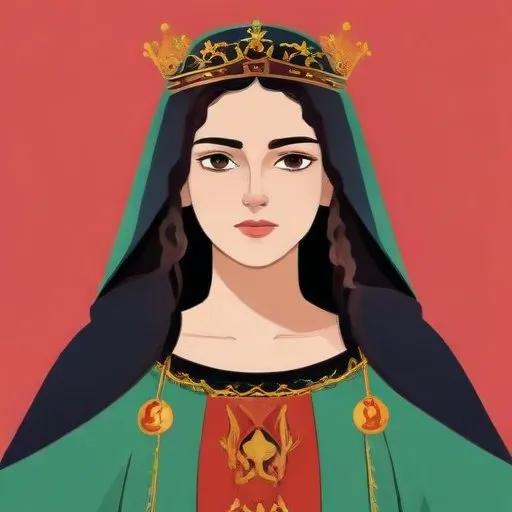
Ruling Sicily from 1377 to 1401, she was a skilled politician and strategist who maintained peace and stability in her kingdom despite facing numerous challenges. She's known for her diplomatic prowess and cultural achievements.
Maria, Queen of Sicily, is renowned for her tumultuous reign, marked by power struggles, kidnappings, and turmoil, from 1377 until her death in 1401. As the daughter and heir of Frederick the Simple, she ascended the Sicilian throne at the tender age of 13, only to have her government taken over by four powerful baronial families.
Born in Catania in 1363, Maria was the daughter of Frederick the Simple and his first wife, Constance of Aragon. Following her father's death in 1377, Maria inherited the Sicilian throne, but her youth and inexperience led to her government being seized by four powerful vicars.
The four vicars, Artale I Alagona, Francesco II Ventimiglia, Manfredi III Chiaramonte, and Guglielmo Peralta, were chosen to represent and distribute power equally between the Sicilian and Aragonese factions. However, this arrangement failed to bring stability, as each vicar ruled independently in their respective baronial lands.
In 1379, Maria was kidnapped by Guglielmo Raimondo III of Moncada, a Sicilian nobleman and member of the Aragonese House of Montcada, who sought to prevent her planned marriage to Giangaleazzo Visconti, Duke of Milan. Maria was held captive for two years, first at Augusta and then at Licata, before eventually being released.
Despite the turmoil that characterized her reign, Maria's legacy is marked by her resilience and determination. Her experiences served as a testament to the challenges faced by women in power during the Middle Ages.
Maria's reign was marked by the ongoing struggle for power between the Sicilian and Aragonese factions, which would continue to shape the history of Sicily for centuries to come. Her experiences serve as a reminder of the complexities and challenges of medieval politics.
Maria's reign can be compared to that of her contemporary, Joanna I of Naples, who also faced similar challenges as a female ruler in a male-dominated society. Both queens demonstrated remarkable resilience and determination in the face of adversity.
Born in 1415
The last of the Habsburg emperors, he ruled the Holy Roman Empire from 1452 to 1493, known for his efforts to reform the empire and strengthen its central authority.
Born in 1208
Conqueror of Valencia and Mallorca, he united the Crown of Aragon and expanded its territories through military campaigns. He also promoted the Catalan language and culture.
Born in 1052
King of France from 1060 to 1108, known for his military campaigns and conflicts with the Church, particularly his excommunication by Pope Urban II.
