


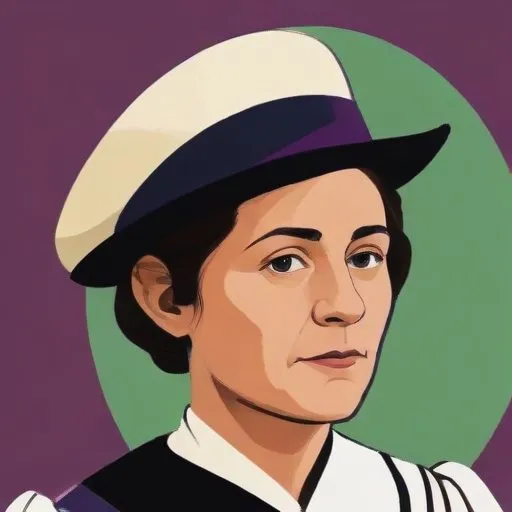
A pioneering sociologist and women's rights activist who advocated for women's suffrage and equality, making significant contributions to the development of sociology and feminist theory.
Marianne Weber, born Marianne Schnitger, was a German sociologist and women's rights activist who made significant contributions to the fields of sociology, philosophy, and women's rights. She is best known for her works on women's rights, marriage, and family, as well as her role as the wife of renowned sociologist Max Weber.
Marianne was born on August 2, 1870, in Oerlinghausen, Germany, to a family of modest means. Her childhood was marked by poverty and hardship, and after her mother's death in 1873, she was raised by her grandmother and aunt. Despite these challenges, Marianne received a solid education, attending local village schools and later graduating from fashionable finishing schools in Lemgo and Hanover.
In 1891, Marianne began to spend time with the Charlottenburg Webers, particularly Max Jr. and his mother, Helene. Her close relationship with Helene inspired many of Marianne's later works, including her critiques of domestic abuse. Marianne and Max Weber started courting and eventually married in 1893, moving to Berlin to pursue their academic careers.
Marianne's work spanned multiple fields, including sociology, philosophy, and women's rights. Her most notable contributions include her critiques of patriarchal societies, her advocacy for women's rights, and her analysis of the role of women in the family. Her book, Frauenfragen und Frauengedanken (Women's Questions and Women's Thoughts), published in 1919, remains a seminal work in the field of feminist sociology.
Her work, Ehefrau und Mutter in der Rechtsentwicklung (Wife and Mother in the Development of Law), published in 1907, examined the legal status of women in marriage and the family.
She was a vocal advocate for women's suffrage, co-founding the German Association for Women's Suffrage in 1902.
Marianne was also a prolific writer, publishing numerous articles and essays on topics ranging from education to politics.
Marianne Weber's pioneering work paved the way for future generations of feminist scholars and activists. Her critiques of patriarchal societies and advocacy for women's rights continue to inspire and inform contemporary debates.
Despite her significant contributions, Marianne's work was often overshadowed by that of her husband, Max Weber. However, in recent years, scholars have sought to recover and reevaluate her contributions, recognizing her as a trailblazing figure in her own right.
1870: Born on August 2nd in Oerlinghausen, Germany
1891: Began spending time with the Charlottenburg Webers, including Max Jr. and his mother, Helene
1893: Married Max Weber and moved to Berlin
1907: Published Ehefrau und Mutter in der Rechtsentwicklung (Wife and Mother in the Development of Law)
1919: Published Frauenfragen und Frauengedanken (Women's Questions and Women's Thoughts)
1954: Passed away on March 12th
Marianne Weber's fascinating life and groundbreaking work serve as a testament to the power of determination, hard work, and a commitment to social justice.
Born in 1864
Developed the concept of "social action" and is known for his theories on bureaucracy, capitalism, and the role of religion in shaping society.
Born in 1858
A founder of modern sociology, known for establishing the field and exploring the relationships between individuals and society, particularly in his work "Suicide".
Born in 1818
A 19th-century philosopher who developed the theory of communism, arguing that capitalism would eventually be replaced by a socialist society. He's known for his critique of capitalism and the concept of class struggle.
Born in 1820
A 19th-century philosopher and economist who co-authored "The Communist Manifesto" with Karl Marx, shaping modern socialist and communist thought. He also wrote extensively on economics, history, and politics.
Born in 1820
A pioneering thinker who coined the phrase "survival of the fittest" and applied evolutionary principles to social sciences, shaping modern sociology and philosophy.
Born in 1798
Developed the concept of sociology and coined the term, creating a framework for understanding social structures and relationships. Known for his Positivism philosophy, emphasizing scientific observation and empirical evidence.
Born in 1802
Pioneering sociologist and writer who helped establish sociology as a distinct field, and is known for her influential writings on social theory, politics, and economics.
Born in 1858
A pioneering social reformer and co-founder of the London School of Economics, known for her groundbreaking work on poverty, labor, and social welfare. Her research and writings greatly influenced British social policy and the development of the welfare state.
