


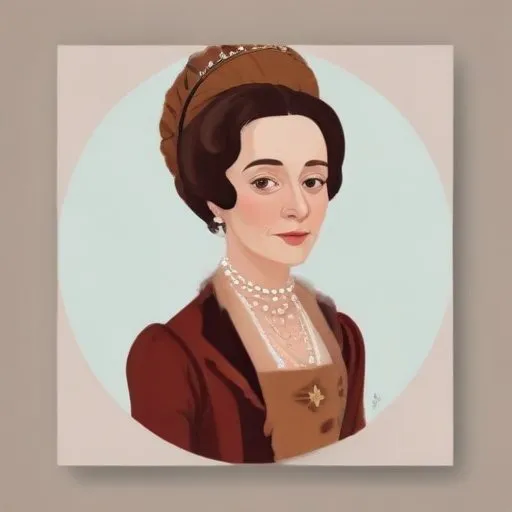
The Duchess of Savoy was a powerful and influential noblewoman who played a significant role in 17th-century European politics and royal courts. She was a skilled diplomat and strategist who navigated complex alliances and marriages to secure her family's interests.
Born as a Princess of Savoy, Marie Jeanne Baptiste of Savoy-Nemours rose to become the Duchess of Savoy through her marriage to Charles Emmanuel II. She is renowned for her significant architectural legacy in Turin, particularly the remodelling of the Palazzo Madama, her private residence, which still stands as a testament to her refined taste and cultural prowess.
Marie Jeanne Baptiste was born on April 11, 1644, at the Hôtel de Nemours in Paris, to Charles Amadeus, Duke of Nemours, and his wife, Princess Élisabeth de Bourbon-Vendôme. She was the eldest of five children and grew up alongside her sister, Marie Françoise, Mademoiselle d'Aumale. Through her mother, she was a great-granddaughter of Henry IV of France, making her a half-first-cousin once removed of Louis XIV and a relation to most Catholic royalty at that time.
Marie Jeanne Baptiste's life was marked by a series of tumultuous events, beginning with her first marriage by proxy to Charles of Lorraine in 1662, which was subsequently annulled. She then married Charles Emmanuel II, Duke of Savoy, in 1665, who was her kinsman. She styled herself as Madama Reale or Madame Royale and went on to become the mother of the future Victor Amadeus II of Sardinia, who would eventually elevate the House of Savoy to kings.
From 1675 to 1680, Marie Jeanne Baptiste acted as Regent of Savoy in the name of her son, Victor Amadeus II, who was her husband's successor. Although her regency officially ended in 1680, she maintained significant power and influence until her son banished her from further involvement in the state in 1684. This tumultuous period was marked by power struggles and controversies, yet she remained a steadfast figure in the politics of Savoy.
Marie Jeanne Baptiste's true legacy lies in her contributions to the architectural landscape of Turin. Her remodelling of the Palazzo Madama, her private residence, showcased her impeccable taste and cultural sophistication. This grand structure still stands today as a testament to her vision and refinement, solidifying her position as a cultural patron and architectural matriarch of Savoy.
Marie Jeanne Baptiste of Savoy-Nemours was a true Renaissance woman, whose life was defined by her unwavering dedication to her family, her culture, and her people. Her architectural legacy continues to inspire and delight, cementing her position as one of the most fascinating and influential women of her time.
Born in 1587
Ruler of Savoy from 1630 to 1637, he played a key role in the Thirty Years' War and expanded his duchy through strategic alliances and military campaigns.
Born in 1562
Ruler of Savoy from 1580 to 1630, he expanded his territories through strategic marriages and military campaigns, earning the nickname "the Great".
Born in 1606
A 17th-century regent who ruled Savoy and Piedmont, known for her cultural and artistic patronage, fostering a Renaissance in the region. She was a strong female leader in a male-dominated era.
Born in 1666
King of Sardinia from 1720 to 1730, he played a crucial role in the War of the Spanish Succession and was eventually crowned King of Sicily. He's known for his military campaigns and territorial expansions.
Born in 1820
Unified Italy's first king, who played a key role in the country's unification and modernization. He's remembered for his strong leadership and diplomatic skills.
Born in 1844
King of Italy from 1878 to 1900, known for unifying Italy and establishing the modern Italian state. He played a key role in Italian politics and foreign policy during his reign.
