


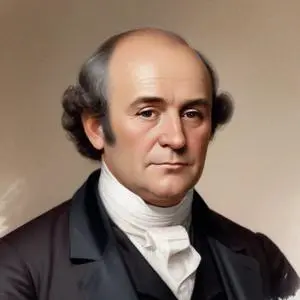
The first president born after American independence, he's known for being a skilled politician and statesman who navigated the country through the Panic of 1837. He's also remembered for being the first president born a citizen of the United States.
Martin Van Buren, the eighth President of the United States, is perhaps best known for his cunning political maneuvering and his founding role in the Democratic Party. From his early days as a lawyer and diplomat to his later years as an elder statesman and antislavery leader, Van Buren's life was marked by a series of firsts and a legacy that continues to shape American politics.
Van Buren was the first president born after the American Revolution, the first to speak English as a second language (his native tongue was Dutch), and the first to serve as president, vice president, U.S. senator, governor, and U.S. secretary of state. This impressive résumé speaks to his remarkable versatility and his ability to adapt to changing circumstances.
Van Buren's political career began in the early 1820s, when he was elected to the New York State Senate as a member of the Democratic-Republican Party. He quickly rose through the ranks, becoming a leader of the Bucktails faction and establishing a powerful political machine known as the Albany Regency. In 1828, he played a key role in Andrew Jackson's presidential campaign, and his services were rewarded with an appointment as Jackson's secretary of state.
Van Buren's political machine, the Albany Regency, was a powerful organization that dominated New York politics for over a decade. Through a combination of patronage, party loyalty, and strategic alliances, Van Buren built a formidable coalition that helped to elect him to the governorship and later to the presidency.
In 1836, Van Buren was elected president, defeating a divided Whig opposition. During his term, he faced a series of economic crises, including the Panic of 1837, which led to widespread unemployment and financial instability. Despite these challenges, Van Buren remained committed to his principles of limited government and states' rights.
One of Van Buren's most significant achievements as president was the establishment of the Independent Treasury System, which allowed the government to keep its funds in a separate account, independent of the state banks. This innovative policy helped to stabilize the national economy and reduce the influence of special interests.
After leaving office, Van Buren continued to be active in politics, emerging as an elder statesman and antislavery leader. In 1848, he ran for president on the Free Soil Party ticket, advocating for the abolition of slavery in the territories. Though he did not win the election, his campaign helped to galvanize public opinion against the spread of slavery.
"Those who have the ability and the inclination to exercise the elective franchise should not be denied it."
Despite his many achievements, Van Buren's presidency was marked by controversy and criticism. However, his legacy as a shrewd politician, a skilled diplomat, and a champion of democracy continues to inspire Americans to this day.
Van Buren's influence on modern society is multifaceted. His establishment of the Democratic Party helped to create a two-party system that has shaped American politics for centuries. His commitment to limited government and states' rights continues to resonate with libertarians and conservatives. And his championing of democracy and human rights has inspired countless Americans to fight for social justice and equality.
In conclusion, Martin Van Buren was a true original – a brilliant strategist, a gifted diplomat, and a passionate advocate for democracy and human rights. His legacy continues to inspire Americans to this day, and his place in the pantheon of American presidents is secure.
Born in 1767
A fiery leader who expanded democracy and shaped the country's economy, known for his populist policies and controversial decisions, including the forced relocation of Native Americans.
Born in 1790
The first vice president to assume the presidency after the death of the incumbent, serving from 1841 to 1845 and annexing the Republic of Texas. He's known for his strong states' rights views and being the first president born after the American Revolution.
Born in 1795
The 11th President of the United States was a strong leader who aggressively expanded the country's territory through the annexation of Texas and the Mexican-American War, nearly doubling the size of the US. He's also known for being a strong advocate for Manifest Destiny.
Born in 1784
The 12th President of the United States was a military hero who led the country to victory in the Mexican-American War, and later became a short-lived president. He's known for his strong leadership and sudden death in office.
Born in 1800
The 13th President of the United States, a member of the Whig party, is known for being a compromise candidate and signing the Compromise of 1850, which attempted to address the issue of slavery in new states. He's also notable for being one of the lesser-known presidents in U.S. history.
Born in 1804
The 14th President of the United States, a northern Democrat who struggled to find a compromise on slavery, ultimately signing the Kansas-Nebraska Act, which allowed new states to decide on slavery. He's often remembered for his inability to prevent the Civil War.
Born in 1791
The 15th President of the United States, a northern Democrat who remained in office during the American Civil War, is infamous for his inaction in preventing the secession of 11 southern states. He's often regarded as one of the worst presidents in US history.
Born in 1809
Led the United States through its Civil War and ultimately abolished slavery, leaving a lasting legacy in American history.
