


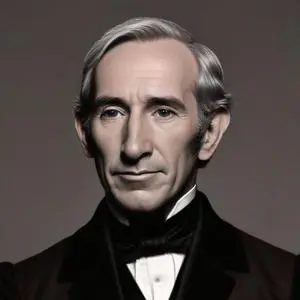
The first vice president to assume the presidency after the death of the incumbent, serving from 1841 to 1845 and annexing the Republic of Texas. He's known for his strong states' rights views and being the first president born after the American Revolution.
John Tyler, the tenth president of the United States, is known for his unexpected rise to power and his strong stance on states' rights. He was the first vice president to succeed to the presidency, and his presidency was marked by controversy and a struggle to assert his authority.
John Tyler was born on March 29, 1790, in Charles City County, Virginia, to a prominent slaveholding family. He studied law and was admitted to the bar in 1809. Tyler began his political career in 1811 as a member of the Virginia House of Delegates, where he served for five years.
Tyler's national reputation grew in the 1820s, during the nullification crisis, when he opposed President Andrew Jackson's actions as infringing on states' rights. He became a leader of the Whig Party and served as governor of Virginia, U.S. representative, and U.S. senator. In 1836, he was the Whig vice presidential nominee, but lost the election.
In 1840, Tyler was chosen as the running mate of William Henry Harrison, the Whig presidential nominee. The campaign slogan "Tippecanoe and Tyler Too" helped to propel them to victory, defeating incumbent president Martin Van Buren. However, Harrison died just one month into his presidency, and Tyler became the first vice president to succeed to the presidency.
Tyler's presidency was marked by controversy and uncertainty. Many questioned his authority, and some considered him an "acting president." He faced opposition from both the Whig and Democratic parties, and his efforts to assert his authority were met with resistance. Despite these challenges, Tyler continued to advocate for states' rights and limited government intervention.
John Tyler's presidency was marked by controversy, but he also achieved significant milestones. He annexed the Republic of Texas, which became the 28th state, and established the precedent for vice presidential succession. His commitment to states' rights and limited government intervention has had a lasting impact on American politics.
Tyler married twice, first to Letitia Christian in 1813, and then to Julia Gardiner in 1844, after Letitia's death. He had eight children with Letitia and seven with Julia. Tyler died on January 18, 1862, at the age of 71, and was buried in Hollywood Cemetery in Richmond, Virginia.
"The great problem of legislation is, so to organize the civil government of a country, that it shall be a government of laws, and not of men."
John Tyler's presidency came at a time of great change and upheaval in the United States. The country was expanding westward, and the debate over slavery was intensifying. Tyler's commitment to states' rights and limited government intervention has had a lasting impact on American politics, shaping the course of the country's development.
Born in 1767
A fiery leader who expanded democracy and shaped the country's economy, known for his populist policies and controversial decisions, including the forced relocation of Native Americans.
Born in 1777
A skilled orator and compromiser who played a crucial role in shaping the country's early development, particularly through his "American System" economic plan. He's also known for his numerous presidential bids and influential leadership in the Senate.
Born in 1782
A renowned lawyer and politician who served as the 14th United States Secretary of State, known for his exceptional oratory skills and influential role in shaping the country's early development.
Born in 1782
A prominent figure in American politics, serving as Vice President and advocating for states' rights, particularly in regards to slavery. He played a significant role in shaping the country's early development.
Born in 1795
The 11th President of the United States was a strong leader who aggressively expanded the country's territory through the annexation of Texas and the Mexican-American War, nearly doubling the size of the US. He's also known for being a strong advocate for Manifest Destiny.
Born in 1784
The 12th President of the United States was a military hero who led the country to victory in the Mexican-American War, and later became a short-lived president. He's known for his strong leadership and sudden death in office.
Born in 1800
The 13th President of the United States, a member of the Whig party, is known for being a compromise candidate and signing the Compromise of 1850, which attempted to address the issue of slavery in new states. He's also notable for being one of the lesser-known presidents in U.S. history.
Born in 1804
The 14th President of the United States, a northern Democrat who struggled to find a compromise on slavery, ultimately signing the Kansas-Nebraska Act, which allowed new states to decide on slavery. He's often remembered for his inability to prevent the Civil War.
