


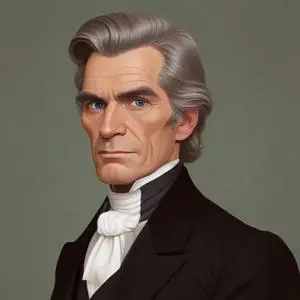
A prominent figure in American politics, serving as Vice President and advocating for states' rights, particularly in regards to slavery. He played a significant role in shaping the country's early development.
Born on March 18, 1782, in South Carolina, Calhoun's rise to prominence began with his election to the House of Representatives in 1810. As a dedicated leader of the war hawk faction, he fervently supported the War of 1812, advocating for a strong federal government and protective tariffs.
In the late 1820s, Calhoun's views underwent a radical transformation, as he became an ardent proponent of states' rights, limited government, nullification, and opposition to high tariffs. This seismic shift in perspective was fueled by his conviction that Northern acceptance of these policies was a necessary condition for the South's continued participation in the Union.
Calhoun's tenure as Vice President, which spanned from 1825 to 1832, was marked by tension and conflict with President Andrew Jackson, primarily due to the Nullification Crisis. This period saw Calhoun fiercely supporting South Carolina's right to nullify federal tariff legislation, which he believed unfairly favored the North. His stance put him at odds with Jackson, who threatened to use military force to enforce federal law.
Calhoun's beliefs and actions have had a lasting impact on American history, influencing the South's secession from the Union in 1860 and 1861. His legacy is complex and multifaceted, with some hailing him as a visionary statesman and others condemning him as a passionate defender of slavery.
Calhoun's ideas and actions continue to shape American politics, with his legacy influencing debates on states' rights, federalism, and the role of government. His passionate defense of slavery, however, remains a contentious and controversial aspect of his legacy.
"The negative of the negative is a positive; and the negative of the positive is a negative."
"The power to tax is the power to destroy."
Calhoun's philosophical views and political actions are often juxtaposed with those of his contemporaries, including President Andrew Jackson and Senator Henry Clay. While Jackson and Calhoun clashed over states' rights and nullification, Clay's American System, which advocated for a strong federal government and infrastructure development, stood in stark contrast to Calhoun's limited government approach.
Calhoun's life and legacy have inspired numerous literary and artistic works, including historian William W. Freehling's biography The Nullification Era: States' Rights and the Formation of the Union and the play A House Divided, which explores the tumultuous relationship between Calhoun and Jackson.
Born in 1767
A fiery leader who expanded democracy and shaped the country's economy, known for his populist policies and controversial decisions, including the forced relocation of Native Americans.
Born in 1777
A skilled orator and compromiser who played a crucial role in shaping the country's early development, particularly through his "American System" economic plan. He's also known for his numerous presidential bids and influential leadership in the Senate.
Born in 1782
A renowned lawyer and politician who served as the 14th United States Secretary of State, known for his exceptional oratory skills and influential role in shaping the country's early development.
Born in 1767
The 6th President of the United States was a skilled diplomat and leader who played a key role in shaping America's foreign policy and expansion. He's also known for being the son of a president and a president himself, making him part of a unique American political dynasty.
Born in 1795
The 11th President of the United States was a strong leader who aggressively expanded the country's territory through the annexation of Texas and the Mexican-American War, nearly doubling the size of the US. He's also known for being a strong advocate for Manifest Destiny.
Born in 1784
The 12th President of the United States was a military hero who led the country to victory in the Mexican-American War, and later became a short-lived president. He's known for his strong leadership and sudden death in office.
Born in 1800
The 13th President of the United States, a member of the Whig party, is known for being a compromise candidate and signing the Compromise of 1850, which attempted to address the issue of slavery in new states. He's also notable for being one of the lesser-known presidents in U.S. history.
Born in 1804
The 14th President of the United States, a northern Democrat who struggled to find a compromise on slavery, ultimately signing the Kansas-Nebraska Act, which allowed new states to decide on slavery. He's often remembered for his inability to prevent the Civil War.
