


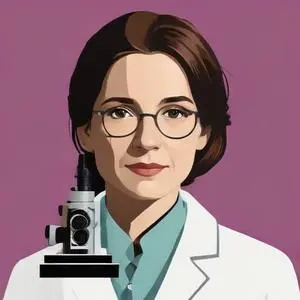
Pioneering geneticist who discovered X-chromosome inactivation, a crucial mechanism for gene expression in mammals, revolutionizing our understanding of genetics and development.
Mary F. Lyon, a renowned English geneticist, made groundbreaking contributions to the field of genetics, earning her a permanent place in the annals of scientific history. She is best known for her discovery of X-chromosome inactivation, a phenomenon that has far-reaching implications for our understanding of genetics and its applications.
Born on May 15, 1925, in Norwich, England, Mary Lyon was the eldest of three children to a civil servant and a schoolteacher. Her interest in science was sparked by a good schoolteacher and nature books she won in an essay competition. She pursued her passion for science at Girton College, Cambridge, where she studied zoology, physiology, organic chemistry, and biochemistry.
During World War II, Mary faced significant challenges as a female student at Cambridge. Despite being one of only 500 female students amidst 5,000 men, she persisted in her studies. Although female students received only titular degrees, she was determined to make a name for herself in the world of genetics. Under the guidance of Professor Ronald Fisher, she worked on a mutant mice strain with a pallid mutation and published her research.
After completing her PhD in 1950, Mary joined the group of Conrad Hal Waddington, where she worked alongside TC Carter to investigate mutagenesis and the genetic risks of radiation. Her research focused on various mutations, including the pallid mutation, ataxia, and twirler mutations. Her work laid the foundation for a deeper understanding of genetics and its applications.
Mary's most significant contribution to the field of genetics is her discovery of X-chromosome inactivation. This phenomenon occurs when one of the two X chromosomes in female mammals is randomly inactivated, leading to a mosaic pattern of gene expression. This discovery has far-reaching implications for our understanding of genetic development, embryology, and the causes of certain genetic disorders.
Mary's pioneering work earned her numerous awards and honors, including the Royal Medal, the Darwin Medal, and the Mauro Baschirotto Award. She was also elected a Fellow of the Royal Society and a member of the European Molecular Biology Organization.
Mary F. Lyon's work has had a profound impact on our understanding of genetics and its applications. Her discovery of X-chromosome inactivation paved the way for further research into genetic development and disease. Her legacy continues to inspire future generations of geneticists, and her work remains a testament to her dedication and perseverance in the face of adversity.
Mary F. Lyon's remarkable career serves as a reminder of the power of determination and perseverance. Her groundbreaking discovery of X-chromosome inactivation continues to influence the field of genetics, and her legacy will be remembered for generations to come.
Born in 1920
A British scientist who contributed significantly to the discovery of the structure of DNA, providing high-quality X-ray crystallography images that helped James Watson and Francis Crick develop their famous model.
Born in 1916
A Nobel Prize-winning physicist and biologist who contributed significantly to the discovery of the structure of DNA, using X-ray crystallography to produce the first clear images of the molecule.
Born in 1916
Pioneering scientist who discovered the structure of DNA, revolutionizing our understanding of genetics and life itself.
98 Years Old
Discovered the structure of DNA, revolutionizing our understanding of genetics and earning a Nobel Prize. Pioneering work in molecular biology has far-reaching implications for medicine and beyond.
Born in 1914
Pioneering crystallographer who unraveled the structure of hemoglobin, revolutionizing our understanding of biological molecules. His work paved the way for major advances in medicine and biochemistry.
Born in 1924
A pioneer in the field of atmospheric physics, known for his groundbreaking research on the ozone layer and climate change, and a vocal skeptic of global warming theories.
Born in 1910
A pioneering scientist who deciphered the structures of biomolecules like insulin and vitamin B12, revolutionizing our understanding of biology and medicine.
Born in 1917
Pioneering biochemist and crystallographer who determined the structure of myoglobin, a protein in muscle cells, and was awarded the Nobel Prize in Chemistry in 1962.
