


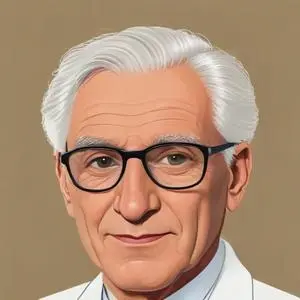
Pioneering crystallographer who unraveled the structure of hemoglobin, revolutionizing our understanding of biological molecules. His work paved the way for major advances in medicine and biochemistry.
Max Perutz, an Austrian-born British molecular biologist, is renowned for his groundbreaking work on the structure of proteins, which earned him the Nobel Prize in Chemistry in 1962. His pioneering research on haemoglobin and myoglobin, in collaboration with John Kendrew, revolutionized our understanding of the molecular basis of life.
Born on May 19, 1914, in Vienna, Austria, Max Perutz was the son of Hugo Perutz, a textile manufacturer, and Adele Dely Goldschmidt. Despite his parents' hopes for him to become a lawyer, Perutz developed a passion for chemistry during his school years.
He pursued his interest in chemistry at the University of Vienna, completing his degree in 1936. Later, he moved to Cambridge, where he joined the renowned biochemist Gowland Hopkins' research group at the University of Cambridge.
At Cambridge, Perutz worked under the guidance of J.D. Bernal, who introduced him to X-ray crystallography. Perutz's early research focused on using X-ray diffraction to study the structure of proteins, particularly haemoglobin.
His innovative approach and meticulous work led to a significant breakthrough in understanding the molecular structure of haemoglobin and myoglobin. This pioneering research laid the foundation for modern molecular biology and earned Perutz the Nobel Prize in Chemistry in 1962.
In 1962, Perutz founded and chaired the Medical Research Council (MRC) Laboratory of Molecular Biology (LMB) at Cambridge, which became a hub for cutting-edge research in molecular biology.
During his tenure, Perutz nurtured a talented community of scientists, many of whom went on to win Nobel Prizes, including Fred Sanger, Francis Crick, and James Watson.
Max Perutz's contributions to molecular biology have had a profound impact on our understanding of life. His work has paved the way for significant advances in fields such as protein engineering, genomics, and structural biology.
Perutz's legacy extends beyond his scientific achievements. He was a passionate advocate for the importance of basic scientific research and was committed to fostering a collaborative and stimulating research environment.
Through his remarkable life's work, Max Perutz has inspired generations of scientists, leaving an indelible mark on the scientific community.
98 Years Old
Discovered the structure of DNA, revolutionizing our understanding of genetics and earning a Nobel Prize. Pioneering work in molecular biology has far-reaching implications for medicine and beyond.
Born in 1916
Pioneering scientist who discovered the structure of DNA, revolutionizing our understanding of genetics and life itself.
Born in 1920
A British scientist who contributed significantly to the discovery of the structure of DNA, providing high-quality X-ray crystallography images that helped James Watson and Francis Crick develop their famous model.
Born in 1916
A Nobel Prize-winning physicist and biologist who contributed significantly to the discovery of the structure of DNA, using X-ray crystallography to produce the first clear images of the molecule.
Born in 1901
Pioneering chemist and peace activist who won two unshared Nobel Prizes, one for chemistry and one for peace, for his groundbreaking work on the nature of the chemical bond and his tireless efforts to promote nuclear disarmament.
Born in 1915
A Nobel Prize-winning biologist and immunologist who made groundbreaking discoveries in tissue transplantation and immunology, leading to significant advancements in organ transplants and our understanding of the immune system.
Born in 1924
A pioneer in the field of atmospheric physics, known for his groundbreaking research on the ozone layer and climate change, and a vocal skeptic of global warming theories.
Born in 1910
A pioneering scientist who deciphered the structures of biomolecules like insulin and vitamin B12, revolutionizing our understanding of biology and medicine.
