


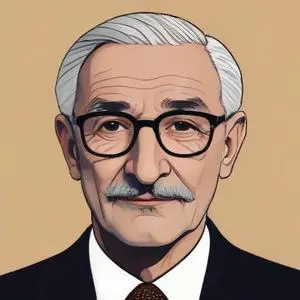
A Nobel Prize-winning biologist and immunologist who made groundbreaking discoveries in tissue transplantation and immunology, leading to significant advancements in organ transplants and our understanding of the immune system.
Renowned for his groundbreaking work on graft rejection and acquired immune tolerance, Sir Peter Brian Medawar is hailed as the father of transplantation. His pioneering discoveries have been fundamental to the medical practice of tissue and organ transplants, revolutionizing the field of medicine.
Born on February 28, 1915, in Petrópolis, Brazil, Medawar was the youngest child of a Lebanese father and a British mother. He held dual citizenship of Brazil and the United Kingdom by birth. Medawar's educational pursuits took him to Marlborough College and later to Magdalen College, Oxford, where he honed his skills in zoology.
Medawar's remarkable career span saw him hold positions as professor of zoology at the University of Birmingham and University College London. He was also the Director of the National Institute for Medical Research at Mill Hill until he was partially disabled by a cerebral infarction. Alongside his doctoral student Leslie Brent and postdoctoral fellow Rupert E. Billingham, Medawar demonstrated the principle of acquired immunological tolerance, a phenomenon that laid the foundation for tissue and organ transplantation.
In 1960, Medawar shared the Nobel Prize in Physiology or Medicine with Sir Frank Macfarlane Burnet for the discovery of acquired immunological tolerance. This prestigious recognition cemented his position as a leading figure in the field of medicine.
Medawar's personal life was marked by a strong sense of humor and wit, earning him the admiration of fellow scientists and writers. Richard Dawkins referred to him as the wittiest of all scientific writers, while Stephen Jay Gould hailed him as the cleverest man he had ever known.
Through his popular writings, Medawar shared his philosophical views on science and its relationship with humanity. He believed that science should be accessible to the masses, and his writings reflected this ideology. Medawar's commitment to making complex scientific concepts easily understandable earned him a wide readership and accolades from the scientific community.
Medawar's groundbreaking work has had a profound impact on modern society. His discoveries have enabled the development of life-saving transplant procedures, improving the quality of life for countless individuals worldwide. His contributions have also paved the way for further research in immunology and transplantation.
Medawar's work has been instrumental in shaping the field of transplantation. His discoveries have led to numerous medical breakthroughs, and his legacy continues to inspire scientists and researchers worldwide. He remains one of the most influential scientists of the 20th century, and his work will continue to have a lasting impact on the world of medicine.
Sir Peter Brian Medawar's remarkable journey, marked by groundbreaking discoveries and a commitment to making science accessible, has left an indelible mark on the world of medicine. His legacy continues to inspire and influence scientists, writers, and thinkers worldwide.
98 Years Old
Discovered the structure of DNA, revolutionizing our understanding of genetics and earning a Nobel Prize. Pioneering work in molecular biology has far-reaching implications for medicine and beyond.
Born in 1916
Pioneering scientist who discovered the structure of DNA, revolutionizing our understanding of genetics and life itself.
Born in 1920
A British scientist who contributed significantly to the discovery of the structure of DNA, providing high-quality X-ray crystallography images that helped James Watson and Francis Crick develop their famous model.
Born in 1916
A Nobel Prize-winning physicist and biologist who contributed significantly to the discovery of the structure of DNA, using X-ray crystallography to produce the first clear images of the molecule.
Born in 1881
Discovered penicillin, a revolutionary antibiotic, and pioneered its use in medicine. This breakthrough has saved countless lives and transformed the field of healthcare.
Born in 1898
Developed penicillin as a medicine, revolutionizing the treatment of bacterial infections. This discovery has saved countless lives and transformed modern medicine.
Born in 1914
Developed the first inactivated poliovirus vaccine, leading to the near eradication of polio, and founded the Salk Institute for Biological Studies.
Born in 1749
Developed the smallpox vaccine, revolutionizing disease prevention and saving countless lives.
