


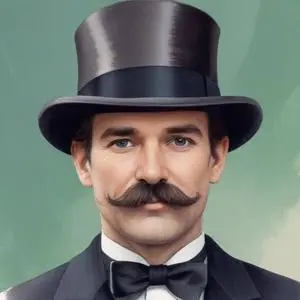
A ruthless and cunning financier who dominated the railroad industry in the late 19th century, known for his clever business tactics and questionable ethics.
Jay Gould, the infamous American railroad magnate and financial speculator, founded the Gould business dynasty and solidified his place as one of the most hated men of the Gilded Age. His cunning business tactics and questionable moral compass earned him a reputation as a ruthless robber baron, amassing a vast fortune that would make him one of the wealthiest men of the late 19th century.
Gould was born on May 27, 1836, in Roxbury, New York, to Mary More Gould and John Burr Gould. His maternal grandfather, Alexander T. More, was a successful businessman, and his great-grandfather, John More, was a Scottish immigrant who founded the town of Moresville, New York. Gould's early life was marked by a strong desire to break free from his family's farming traditions, opting instead to pursue a career in business.
Gould's big break came when he landed a job as a bookkeeper for a blacksmith, a position that would eventually lead to him being offered half interest in the business. He sold his share to his father in 1854 and devoted himself to private study, focusing on surveying and mathematics. In 1854, he surveyed and created maps of the Ulster County, New York, area, and in 1856, he published History of Delaware County, and Border Wars of New York, a book that showcased his meticulous research and writing skills.
Gould's entrepreneurial spirit soon led him to finance operators making woodash for tannin used in tanning leather. This side venture eventually led to a partnership with Zadock Pratt to create a tanning business in Pennsylvania, which he would later buy out and rename Gouldsboro. His business acumen and shrewd tactics caught the attention of Charles Mortimer Leupp, a leading leather merchant, with whom he formed a partnership in 1856.
Gould's foray into the railroad industry began in the 1860s, when he invested in the Rutland and Washington Railroad. He would go on to amass a vast fortune by manipulating stock prices, bribing officials, and engaging in other unscrupulous business practices. His ruthlessness and cunning earned him the title of "Mephistopheles of Wall Street."
Gould's railroad empire expanded rapidly, with him gaining control of the Erie Railroad, the Union Pacific Railroad, and the Missouri Pacific Railroad, among others. His influence extended to banking and finance, with him playing a significant role in the Panic of 1873.
Gould's personal life was marked by controversy, with rumors of insider trading, bribery, and questionable business dealings dogging him throughout his career. He was known for his reclusive nature, preferring to keep a low profile despite his immense wealth and influence.
Gould's family life was also marred by tragedy, with the death of his wife, Helen Day Miller Gould, in 1889. He would go on to marry again, but his later years were marked by declining health and increasing isolation.
Jay Gould's legacy is a complex and contentious one. While he was undoubtedly a brilliant entrepreneur and financier, his questionable business practices and unscrupulous tactics have earned him a place among the most reviled figures of the Gilded Age.
Despite his controversial reputation, Gould's contributions to the development of the American railroad system and his role in shaping the country's financial landscape cannot be ignored. He remains one of the most fascinating and enigmatic figures of American business history.
"I am a speculation, and I speculate."
"It is the duty of the man of wealth to take care that his surplus wealth is used for the good of humanity."
At the height of his power, Gould's net worth was estimated to be around $70 million, equivalent to over $2 billion in today's dollars. His financial influence extended far beyond his personal wealth, with his business dealings and investments shaping the course of American industry and finance.
Born in 1794
Built railroad empires, revolutionizing transportation and commerce, and donated extensively to education and the arts.
Born in 1837
Founded a powerful banking dynasty and dominated corporate finance, shaping the American economy through strategic investments and mergers.
Born in 1839
Founded the Standard Oil Company, revolutionizing the oil industry and amassing vast wealth, which he later used for philanthropic efforts. He's remembered for his business acumen and generosity.
Born in 1835
A self-made industrialist who amassed a vast fortune in the steel industry, then donated most of it to fund over 2,500 public libraries and other philanthropic endeavors.
Born in 1848
A pioneer in the railroad industry, he transformed transportation in the United States through strategic investments and innovative management practices. His philanthropic efforts also supported conservation and education initiatives.
Born in 1838
Built the Great Northern Railway, connecting the Midwest to the Pacific Northwest, revolutionizing transportation and commerce in the region.
Born in 1822
Built the Central Pacific Railroad, a crucial part of the First Transcontinental Railroad, revolutionizing transportation and commerce in the United States.
