


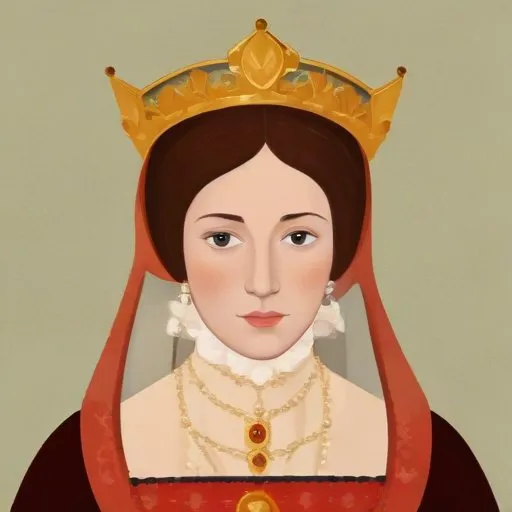
Sovereign Duchess regnant of Burgundy, married to Maximilian I, Holy Roman Emperor, who ruled Burgundy and played a crucial role in shaping European politics and history through her marriage and alliances. She's also known for her cultural and artistic patronage.
Mary of Burgundy, nicknamed "the Rich," was a trailblazing figure in European history, known for her wise leadership and strategic marriages that shaped the course of European politics. As the only child of Charles the Bold, Duke of Burgundy, and his wife Isabella of Bourbon, Mary inherited the Burgundian lands at the age of 19, becoming one of the most powerful women of her time.
Mary's life was marked by a series of strategic alliances and marriages that secured her position as a major player in European politics. Her marriage to Maximilian of Austria not only saved her lands from being annexed by France but also changed the dynasty from Valois to Habsburg, setting the stage for a centuries-long French-Habsburg rivalry.
Born in Brussels in 1457, Mary was raised in a world of power and privilege. Her birth was attended by a clap of thunder, which was seen as a sign of good fortune by the court chronicler Georges Chastellain. As the goddaughter of Louis, Dauphin of France, Mary's early life was marked by lavish ceremonies and grand expectations.
Mary's reign was marked by her shrewd leadership and ability to navigate the complex web of alliances and rivalries that defined European politics. She skillfully countered the ambitions of the French king Louis XI, preserving her lands and securing her position as a major player in European politics.
Mary's untimely death in 1482 marked the end of the Burgundian dynasty and paved the way for the rise of the Habsburgs. Despite her short reign, Mary's legacy continues to shape European politics to this day, earning her a place in history as one of the most influential women of the Middle Ages.
Mary's strategic marriages and alliances not only shaped European politics but also laid the groundwork for modern-day international relations. Her legacy continues to inspire women in leadership positions, offering a powerful reminder of the impact that one person can have on the course of history.
In conclusion, Mary of Burgundy's life was a testament to her shrewd leadership, strategic thinking, and vision for a united Europe. As one of the most influential women of the Middle Ages, her legacy continues to inspire and shape the course of European politics to this day.
Born in 1433
The last Valois Duke of Burgundy, he unified the Burgundian territories and fought to create a kingdom, leaving a legacy of cultural and economic achievements. His ambitions and military campaigns shaped European politics and history.
Born in 1380
Unified the Crown of Aragon, ruling over a vast territory in eastern Spain, and sponsored the voyages of Christopher Columbus, leading to the discovery of the New World.
Born in 1451
Unified the Spanish kingdoms, sponsored Christopher Columbus's voyage to the Americas, and established the Spanish Inquisition.
Born in 1505
Governor of the Habsburg Netherlands, known for her strong leadership and cultural patronage, fostering a golden age of arts and literature.
Born in 1478
The King of Castile and ruler of Burgundy, known for his lavish spending and cultural achievements, including the construction of the Palace of Coudenberg in Brussels.
Born in 1371
A powerful and ambitious duke who ruled Burgundy in the 15th century, known for his military conquests and role in the Hundred Years' War.
