


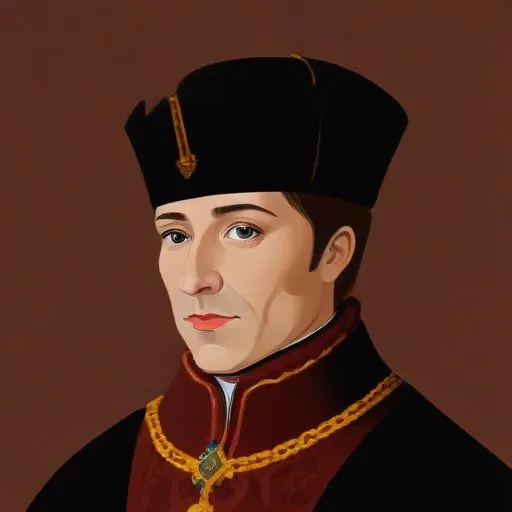
The last Valois Duke of Burgundy, he unified the Burgundian territories and fought to create a kingdom, leaving a legacy of cultural and economic achievements. His ambitions and military campaigns shaped European politics and history.
Charles the Bold, also known as Charles Martin, was the last Duke of Burgundy from the Burgundian cadet branch of House of Valois, reigning from 1467 to 1477. He is remembered for his relentless pursuit of power, influence, and territorial expansion, earning him the nickname "The Bold."
Born on November 10, 1433, Charles was the only legitimate son of Philip the Good and his third wife, Isabella of Portugal. From a young age, he was appointed as the Count of Charolais, setting him on a path to vie for power and influence. His most notable rivalry was with Louis XI, the King of France, which sparked a series of disputes and events throughout his life, including the War of the Public Weal.
Upon ascending to the Duchy of Burgundy in 1467, Charles set his sights on achieving independence from France and forging a kingdom from the North Sea to the borders of Savoy. He successfully added Guelders and Upper Alsace to his realm, and even attempted to become the King of the Romans. However, this ambition earned him the enmity of the Germans.
To further his goals, Charles formed strategic alliances through marriage. He wed Margaret of York, sister of Edward IV of England, solidifying an English alliance. He also arranged the betrothal of his daughter, Mary, to Maximilian, son of the Holy Roman Emperor, Frederick III.
Charles was a devoted patron of the arts, supporting the production of illuminated manuscripts and music. He was a skilled composer and musician himself, and his court became renowned for its elegance, etiquette, and cultural sophistication.
Charles was obsessed with order and regulation, drafting numerous ordinances throughout his rule. These decrees governed military matters, legislation, and diplomacy with meticulous detail. His patron saint was Saint George, and he was frequently urged by the Pope and the Venetians to embark on a crusade against the Ottoman Turks.
Towards the end of his life, Charles became embroiled in the multinational conflict known as the Burgundian War (1474-1477). He fought to protect his rights over Upper Alsace and annex la. Unfortunately, his life was cut short on January 5, 1477, when he fell in battle.
Charles the Bold's legacy is a testament to his unwavering ambition and vision for a unified kingdom. Although his life was marked by rivalries and conflicts, he left an indelible mark on the world of art, chivalry, and politics.
Born in 1457
Sovereign Duchess regnant of Burgundy, married to Maximilian I, Holy Roman Emperor, who ruled Burgundy and played a crucial role in shaping European politics and history through her marriage and alliances. She's also known for her cultural and artistic patronage.
Born in 1371
A powerful and ambitious duke who ruled Burgundy in the 15th century, known for his military conquests and role in the Hundred Years' War.
Born in 1478
The King of Castile and ruler of Burgundy, known for his lavish spending and cultural achievements, including the construction of the Palace of Coudenberg in Brussels.
Born in 1710
The monarch who ruled France from 1715 to 1774, known as the "Sun King's" great-grandson, and remembered for his extravagance, absolutism, and the decline of the French monarchy.
Born in 1284
The king whose disastrous reign led to his eventual deposition and mysterious death, remembered for his alleged homosexual relationships and power struggles with nobles.
