


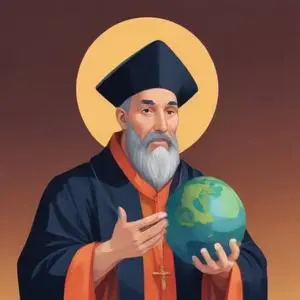
A 16th-century Jesuit priest who introduced Western science and Christianity to China, mapping the country and earning the respect of its rulers. He's credited with facilitating cultural exchange between East and West.
Matteo Ricci, a 16th-century Italian Jesuit priest, is renowned for being one of the founding figures of the Jesuit China missions and creating the iconic Kunyu Wanguo Quantu, a 1602 map of the world written in Chinese characters. This groundbreaking cartographer, linguist, and philosopher not only entered theForbidden City of Beijing but also forged lasting bonds between European and Chinese cultures.
Born on October 6, 1552, in Macerata, part of the Papal States (now in the Italian region of Marche), Ricci studied the classics in his native hometown and later pursued law at Rome for two years. In 1571, he entered the Society of Jesus at the Roman College, where he delved into philosophy, theology, mathematics, cosmology, and astronomy under the guidance of Christopher Clavius.
In 1577, Ricci applied for a missionary expedition to the Far East, and in 1578, he sailed from Lisbon, Portugal, arriving in Goa, a Portuguese colony, the following September. He spent four years teaching and ministering in Goa before being summoned to Macau in 1582 to prepare for his entry into China.
Upon arriving in Macau, Ricci began mastering the Chinese language and writing system. He adopted the Chinese name Li Madou, which means "Master Matthew," and donned traditional Chinese attire to facilitate his integration into Chinese society.
In 1601, Ricci became the first European to enter the Forbidden City of Beijing, invited by the Wanli Emperor himself. The emperor sought Ricci's expertise in court astronomy and calendrical science, marking the beginning of a fruitful collaboration between the two.
Ricci emphasized the parallels between Catholicism and Confucianism, which helped him gain the respect and trust of Chinese intellectuals. He, however, opposed Buddhism, viewing it as a threat to Catholicism. Through his interactions with prominent Chinese officials, Ricci converted several to Catholicism, including Xu Guangqi, with whom he collaborated on translating Euclid's Elements into Chinese and the Confucian classics into Latin.
Ricci's remarkable achievements have left an indelible mark on the history of cultural exchange between Europe and China. In 2022, the Apostolic See recognized his heroic virtues, bestowing upon him the honorific of Venerable. His Kunyu Wanguo Quantu map remains a testament to his cartographic prowess and his role as a bridge between two civilizations.
Ricci's legacy extends beyond his missionary work, as he played a crucial role in introducing European knowledge to China and facilitating cross-cultural understanding. His translation of Confucian classics into Latin and his collaboration on the Kunyu Wanguo Quantu map paved the way for future cultural exchange and cooperation.
Born in 1506
Co-founder of the Society of Jesus, a Catholic religious order, known for his missionary work in Asia, especially in India and Japan, and for his role in the Counter-Reformation. He's revered for his tireless efforts to spread Christianity and his compassion for the poor and marginalized.
