


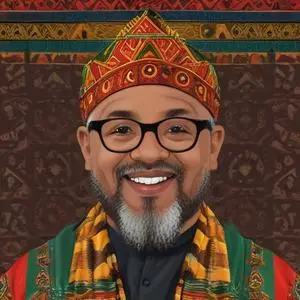
Creator of Kwanzaa, a week-long celebration honoring African American culture and heritage, and a prominent figure in the Black Power movement. Known for promoting unity, self-determination, and cultural pride among African Americans.
Maulana Ndabezitha Karenga, an American activist, author, and professor of Africana studies, is best known for creating the pan-African and African American holiday of Kwanzaa. This seven-day celebration, observed from December 26 to January 1, honors African traditions and promotes unity among people of African descent.
Born Ronald McKinley Everett on July 14, 1941, in Parsonsburg, Maryland, Karenga grew up in a family of 14 children. His father, Levi Everett, was a tenant farmer and Baptist minister. Karenga studied at Los Angeles City College and the University of California, Los Angeles, where he became involved in the Black Power movement of the 1960s.
In 1966, Karenga created Kwanzaa, modeling the holiday after African first fruit traditions. The rituals of Kwanzaa promote African traditions, including the seven principles of African heritage, known as the Nguzo Saba. These principles are:
Karenga's involvement in the Black Power movement led him to co-found the black nationalist group US Organization in 1965. However, the group became embroiled in violent clashes with the Black Panther Party by 1969. In 1971, Karenga was convicted of felony assault, torture, and false imprisonment of women, a charge he denied and claimed was politically motivated. He served time in California Men's Colony until his parole in 1975.
Karenga has been awarded two doctorates, one in Political Science in 1976 and one in Social Ethics in 1994. He currently chairs the Africana Studies Department at California State University, Long Beach, and has authored several books on African American culture and history.
Karenga's creation of Kwanzaa has had a profound impact on African American culture, promoting unity, self-awareness, and cultural pride. Today, Kwanzaa is celebrated by millions of people around the world, and its principles have inspired social and economic initiatives in Africa and the African diaspora.
Karenga's words continue to inspire and educate, reminding us of the importance of community, culture, and self-determination:
"The struggle is not for visibility, but for values."
"You can't have a revolution without a vision."
"Kwanzaa is not just a holiday, but a way of life."
Karenga has received numerous awards and honors for his contributions to African American culture and education, including the National Council of Black Studies' Lifetime Achievement Award and the National Association of Black Journalists' Community Service Award.
Karenga's life has been marked by both triumph and turmoil, from the creation of Kwanzaa to his imprisonment and later redemption. Through it all, he has remained committed to his vision of a united and self-determined African diaspora.
Born in 1925
A prominent figure in the Civil Rights Movement, advocating for African American rights and self-defense, and a powerful orator who inspired a generation.
97 Years Old
A prominent leader in the civil rights movement, advocating for racial equality and social justice through nonviolent means, leaving a lasting impact on American history.
85 Years Old
A prominent figure in the Civil Rights Movement, advocating for Black Power and self-defense, and famously coining the term "Black Power" in 1966. Known for his radical approach to achieving racial equality.
84 Years Old
Co-founder of the Black Panther Party, a revolutionary socialist organization that advocated for African American empowerment and challenged police brutality in the 1960s and 1970s. Known for his charismatic leadership and radical ideology.
Born in 1897
Leader of the Nation of Islam, promoting black empowerment and separatism through a unique blend of Islam and black nationalism. Known for his controversial teachings and influence on prominent figures like Malcolm X.
93 Years Old
Leader of the Nation of Islam, promoting black empowerment and self-sufficiency, while also sparking controversy with anti-Semitic and homophobic remarks. 42
92 Years Old
A leading figure in the Black Arts Movement, known for provocative and politically charged poetry, plays, and essays that explored African American identity and social justice. 42
73 Years Old
A prominent public intellectual and social justice advocate, known for his provocative writings and lectures on race, politics, and culture.
