


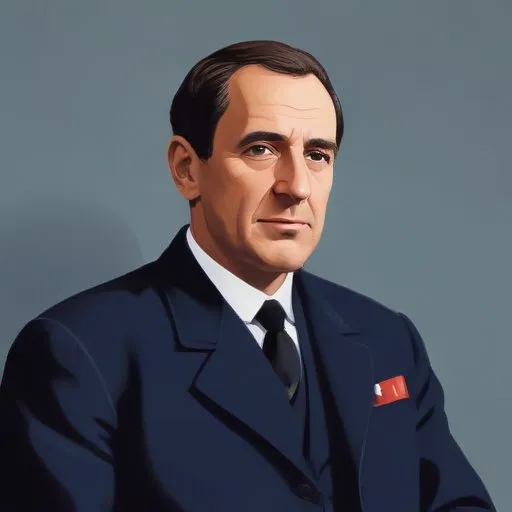
French mountaineer and politician who led the first expedition to climb Annapurna, the highest peak in the Himalayas, and later served as Minister of Youth Affairs and Sports. He's known for his bravery and leadership in extreme conditions.
Maurice Herzog is a name etched in the annals of mountaineering history, synonymous with bravery, determination, and a dash of French flair. He is famously known for leading the 1950 French Annapurna expedition, which successfully conquered the treacherous Annapurna I, becoming the first climbers to ascend a peak above 8,000 meters.
On June 3, 1950, Herzog and his trusted companion, Louis Lachenal, stood at the summit of Annapurna I, defying the odds and pushing the limits of human endurance. This monumental achievement was all the more remarkable given the fact that they did it without supplemental oxygen, a feat that would not be repeated for many years to come.
The descent from the peak proved to be a harrowing experience, with both climbers facing severe frostbite, and subsequently, gangrene. The team's emergency doctor had to perform amputations in the field, resulting in Herzog losing all his toes and most of his fingers. This ordeal, however, did little to dampen Herzog's spirit, and he went on to write a bestselling book about the expedition, aptly titled Annapurna.
In recognition of his remarkable achievement, Herzog was awarded the prestigious Gold Medal of the Socit de Gographie in 1950. This honor was a testament to his unwavering dedication and perseverance in the face of overwhelming adversity.
Annapurna I would not be climbed again until 1970, when a British Army expedition led by Colonel Henry Day successfully ascended the north face, and an expedition led by Chris Bonington conquered the south face. Herzog's feat had set a new benchmark for mountaineers, inspiring generations to come.
"The highest mountain is not the most important thing, it is the depth of your own soul that matters." – Maurice Herzog
This quote encapsulates Herzog's philosophical approach to mountaineering, highlighting the importance of inner strength and resilience in the face of external challenges.
Maurice Herzog's remarkable life and achievements serve as a testament to the human spirit's capacity for greatness. His unwavering passion for mountaineering, combined with his unshakeable resolve, have left an indelible mark on the world of adventure and exploration.
Born in 1921
A pioneering mountaineer who conquered numerous peaks in the French Alps and Himalayas, earning the nickname "The Conqueror of the Useless."
Born in 1919
First person to reach the summit of Mount Everest, leading a historic expedition in 1953, and a humanitarian who worked to improve the lives of Nepalese people.
Born in 1914
First Nepalese-Indian person to reach Mount Everest's summit, alongside Sir Edmund Hillary, marking a historic achievement in mountaineering.
82 Years Old
First person to climb all 14 eight-thousander peaks, including Mount Everest, and a renowned explorer of remote regions. He has written extensively about his expeditions and has held public office in Italy.
84 Years Old
Austrian mountaineer and skier who pioneered a new style of alpine climbing, emphasizing speed, minimal equipment, and partnership, and first ascended the North Face of the Eiger with Reinhold Messner. He's also a renowned ski instructor and author.
96 Years Old
A renowned Italian journalist and mountaineer, he's famous for his daring solo ascents and record-breaking climbs in the Himalayas, inspiring generations of adventurers.
Born in 1914
Italian skier and mountaineer who made the first ascent of K2, the second-highest mountain in the world, in 1954. He was a pioneering figure in high-altitude mountaineering.
