


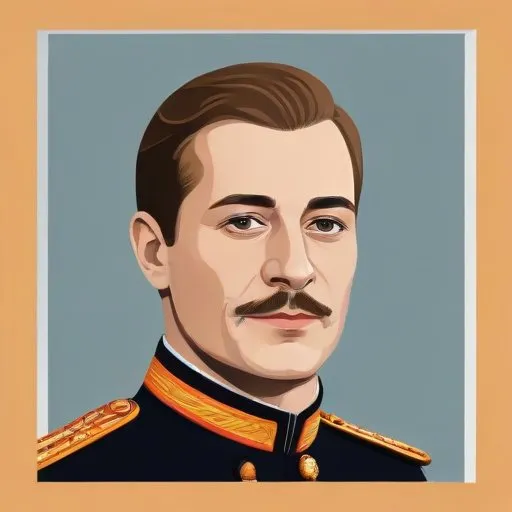
The last Archduke of Austria, a Habsburg ruler who played a key role in the Austro-Hungarian Empire's decline, and is remembered for his attempts to reform the empire and prevent its downfall.
Maximilian III, born on October 12, 1558, was a member of the influential House of Habsburg and the Archduke of Further Austria from 1612 until his death in 1618. He is perhaps best known for his claim to the Polish throne, which led to the War of the Polish Succession (1587-1588), a significant conflict in European history.
Maximilian was born in Wiener Neustadt, Austria, as the fourth son of Emperor Maximilian II and Maria of Spain. Through his mother, he was a grandson of Anna of Bohemia and Hungary, daughter and heiress of Vladislaus II of Bohemia and Hungary, making him a descendant of the Jagiellonian dynasty.
In 1585, Maximilian became the Grand Master of the Teutonic Order, earning him the epithet "der Deutschmeister" or "the German Master". This position granted him significant influence and power within the region.
In 1587, Maximilian stood as a candidate for the throne of the Polish-Lithuanian Commonwealth, following the death of the previous king, Stephen Báthory. Although a portion of the Polish nobility elected him king, another faction elected Prince Sigismund of Sweden, Sigismund III Vasa, leading to the War of the Polish Succession.
Maximilian's invasion of Poland was met with significant opposition, and his forces ultimately clashed with those of Sigismund III Vasa at the Battle of Byczyna on January 24, 1588. Maximilian was defeated and captured, only to be released a year and a half later after the intervention of Pope Sixtus V.
In 1598, Maximilian formally renounced his claim to the Polish crown. He continued to serve as the Archduke of Further Austria until his death on November 2, 1618.
Despite his shortcomings, Maximilian III remains an important figure in European history, known for his ambitious pursuits and his role in shaping the fate of the Polish-Lithuanian Commonwealth.
65 Years Old
The current head of the former ruling dynasty of Austria-Hungary, he is a politician and advocate for European unity and human rights, known for his efforts to promote democracy and reconciliation.
Born in 1912
The last Crown Prince of Austria-Hungary was the heir to the throne of the former Austro-Hungarian Empire, and is known for his efforts to promote European unity and cooperation. He was a prominent politician and writer who played a key role in shaping European politics after World War II.
