


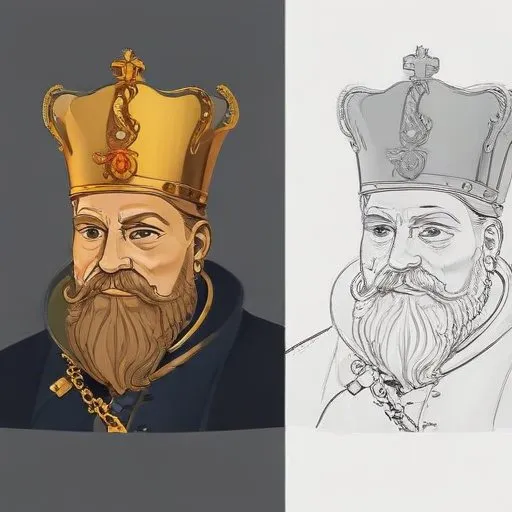
The Polish and Swedish monarch who ruled from 1587 to 1632, known for his attempts to restore Catholicism in Sweden and his involvement in the Polish-Lithuanian Commonwealth's Golden Age. He played a significant role in shaping the fate of Eastern Europe during the 17th century.
Sigismund III Vasa, also known as Zygmunt III Waza in Polish and Žygimantas Vaza in Lithuanian, is renowned for his unwavering dedication to the Catholic Church and his ambitious quest to unify Poland and Sweden under one Catholic kingdom. As the first Polish sovereign from the House of Vasa, he reigned as King of Poland and Grand Duke of Lithuania from 1587 to 1632, and as King of Sweden and Grand Duke of Finland from 1592 to 1599.
Sigismund was born on June 20, 1566, to King John III of Sweden and his first wife, Catherine Jagiellon, daughter of King Sigismund I of Poland. This royal heritage set the stage for his future reign, as he was elected monarch of the Polish-Lithuanian Commonwealth in 1587.
Sigismund's zeal for Catholicism led him to impose Roman Catholicism across his vast realm, sparking a period of significant territorial expansion for Poland. His crusades against neighboring states, including Russia and the Ottoman Empire, showcased his military prowess and unwavering commitment to his faith.
In 1592, Sigismund succeeded his deceased father as King of Sweden, marking the creation of the Polish-Swedish union. Although his efforts to merge the two nations under a single Catholic kingdom ultimately failed, his attempts highlighted his vision for a united Catholic Europe.
Sigismund's reign was marked by controversy, as he frequently clashed with Protestant Sweden and sought to consolidate power by undermining parliament. His close ties with the Jesuits, whom he employed as advisors and spies during the Counter-Reformation, also sparked criticism.
Sigismund's military campaigns had mixed results. He invaded Russia during the Time of Troubles, briefly controlling Moscow and seizing Smolensk. His army also defeated Ottoman forces in southeastern Europe, contributing to the downfall of Sultan Osman II. However, the Polish-Swedish conflict ended in a truce, with King Gustavus Adolphus of Sweden eventually annexing parts of Polish Livonia.
Sigismund III Vasa remains a complex and multifaceted figure in Polish history. While his unwavering commitment to Catholicism and his military campaigns have been praised, his authoritarian tendencies and clashes with Protestant Sweden have drawn criticism. Nevertheless, his reign marked a period of prosperity and achievement for Poland, earning him a lasting place in the country's history.
Born in 1595
The Polish king who ruled from 1632 to 1648, known for his military campaigns and cultural achievements, including the establishment of the first Polish opera house. He was a strong leader who promoted arts and education.
Born in 1629
The Polish-Lithuanian king who led the Polish-Lithuanian Commonwealth to victory against the Ottoman Empire in the Battle of Vienna in 1683, saving Europe from Ottoman conquest. He's also known for his military prowess and cultural achievements.
Born in 1670
A powerful Polish king who transformed his country into a major European power through military conquests and cultural achievements, earning him the nickname "the Strong".
Born in 1677
The last king of Poland before the country's partitions, he's known for his diplomatic skills and attempts to reform the Polish-Lithuanian Commonwealth. He's also famous for being the father-in-law of Louis XV of France.
Born in 1657
King of Prussia from 1701 to 1713, crowned himself king, and established Berlin as his capital, transforming Prussia into a major power. He's known for his cultural and economic reforms.
Born in 1622
King of Sweden from 1654 to 1660, known for his military conquests and expansion of the Swedish Empire, particularly in the Second Northern War.
Born in 1778
King of Sweden from 1792 to 1809, known for his disastrous foreign policy and military failures, leading to the loss of Finland to Russia.
