


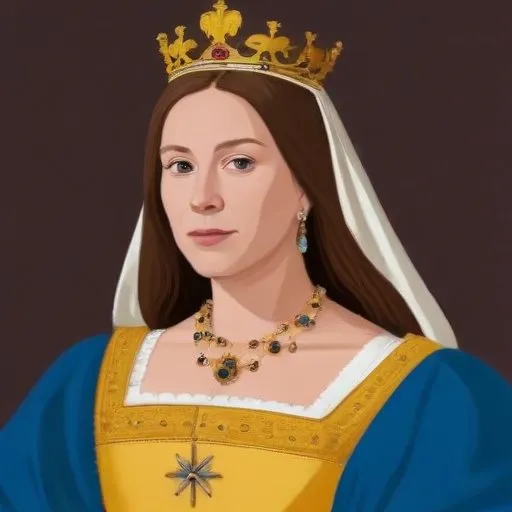
The queen who brought Catholicism to Lutheran Sweden and played a key role in the country's politics during the 16th century. She was a skilled diplomat and strategist who navigated the complexities of royal politics.
Catherine Jagiellon, also known as Katarzyna Jagiellonka, was a Polish-Lithuanian Commonwealth princess who rose to become the Queen of Sweden from 1569 to 1583. She is best known for her significant influence over state affairs during the reign of her husband, King John III, and her efforts to introduce the Counter-Reformation in Sweden.
Catherine was born on November 1, 1526, in Krakow, Poland, as the youngest daughter of King Sigismund I the Old of the Polish-Lithuanian Commonwealth and his wife, Bona Sforza of Milan. She received a thorough Renaissance education, taught by Italian tutors, which included reading, writing, and speaking Latin, German, and Italian, as well as instruction in conversation, riding, dancing, singing, and playing several musical instruments.
After the death of her father in 1548, Catherine and her unmarried sisters, Anna and Sophia, moved to Masovia with their mother. In 1556, when her sister Sophia married and left for Germany, and her mother departed for Italy, Catherine and her sister Anna were moved to the Palace of Vilnius by their brother Sigismund II Augustus of Poland, to ensure a royal presence in Lithuania. During their stay in Vilnius, Catherine and Anna were allowed to compose their own separate households and socialized with the aristocracy, living in a palace and a court strongly influenced by the Italian Renaissance.
Catherine was described as the most beautiful of her sisters, but she was married late for a princess of the era. Her family wanted to ensure a marriage of the highest political status for Poland, and the marriages proposed to her demanded protracted negotiations which ultimately came to nothing. It wasn't until 1562 that Catherine married King John III of Sweden, and she became the Queen of Sweden.
Catherine had significant influence over state affairs during the reign of her husband, King John III. She negotiated with the Pope to introduce the Counter-Reformation in Sweden, aiming to counter the effects of the Protestant Reformation. Her efforts led to the establishment of the Jesuit Order in Sweden and the foundation of several Catholic schools and seminaries.
Catherine was the mother of Sigismund, who went on to become the King of Poland from 1587 to 1632 and the King of Sweden from 1592 to 1599. Her son's reign marked a significant period in Polish and Swedish history, with Sigismund playing a crucial role in shaping the politics and culture of both countries.
Catherine Jagiellon's legacy extends beyond her influential marriage and her efforts to introduce the Counter-Reformation in Sweden. She played a vital role in shaping the politics and culture of both Poland and Sweden, leaving a lasting impact on the history of both countries. Her story serves as a testament to the power and influence of women in the Renaissance era.
Born in 1566
The Polish and Swedish monarch who ruled from 1587 to 1632, known for his attempts to restore Catholicism in Sweden and his involvement in the Polish-Lithuanian Commonwealth's Golden Age. He played a significant role in shaping the fate of Eastern Europe during the 17th century.
Born in 1496
Led a successful rebellion against Danish rule, establishing Sweden as an independent nation and laying the groundwork for its future prosperity.
Born in 1533
The first king of the Vasa dynasty, who ruled Sweden from 1560 to 1568, known for his brutal and erratic behavior, leading to his deposition and eventual murder. He's infamous for his paranoia and violence, earning him a notorious reputation in Swedish history.
Born in 1609
The last king of the Polish-Lithuanian Commonwealth, who fought to preserve his country's independence and unity, and is remembered for his bravery and diplomatic efforts.
