


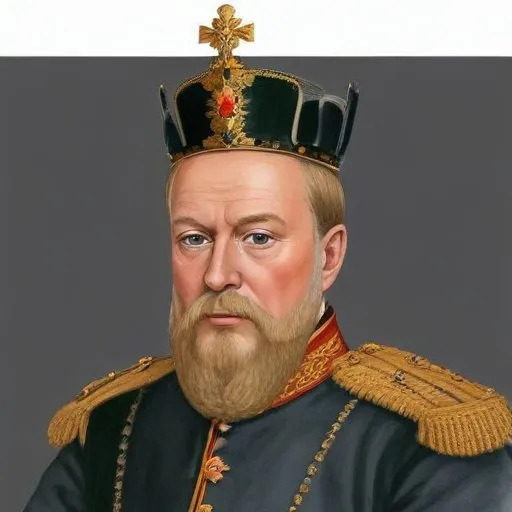
The last Jagiellonian king of Poland and Grand Duke of Lithuania, who united the two countries and established a strong, centralized government, known for his diplomatic skills and cultural achievements.
Sigismund II Augustus, also known as Zygmunt II August, was the last male monarch from the Jagiellonian dynasty, ruling as King of Poland and Grand Duke of Lithuania from 1548 to 1572. He is renowned for his tolerance towards minorities, cultural patronage, and the formation of the Polish-Lithuanian Commonwealth, which marked the apex of the Polish Golden Age.
Sigismund II Augustus was born on August 1, 1520, to Sigismund I the Old and Italian-born Bona Sforza. As the only son, he was groomed and extensively educated as a successor from a young age. In 1529, he was crowned vivente rege, alongside his still-reigning father, signifying his future role as king.
Sigismund II Augustus continued his father's tolerance policy towards minorities, maintaining peaceful relations with neighboring countries, except for the brief Northern Seven Years' War, which aimed to secure Baltic trade. Under his patronage, culture flourished in Poland, and he became a collector of tapestries from the Low Countries, military memorabilia, swords, armors, and jewelry.
His reign saw the establishment of the first regular Polish navy and the first regular postal service in Poland, known today as Poczta Polska. In 1569, he oversaw the signing of the Union of Lublin, which formed the Polish-Lithuanian Commonwealth and introduced an elective monarchy.
Sigismund II Augustus married three times. His first wife, Elizabeth of Austria, died in 1545 at the age of 18. He was then involved in several relationships with mistresses, the most famous being Barbara Radziwi, who became his second wife and Queen of Poland in spite of his mother's disapproval. The marriage was deemed scandalous and was fiercely opposed by the royal court and the nobility. Barbara died five months after her coronation, with rumors circulating that she was poisoned.
Sigismund finally wedded Catherine of Austria but remained childless throughout his life.
Sigismund II Augustus' reign is widely regarded as the peak of the Polish Golden Age. He played a crucial role in shaping the Polish-Lithuanian Commonwealth, which endured for over two centuries. His cultural patronage and tolerance towards minorities have left a lasting impact on Polish society.
Sigismund II Augustus' legacy extends beyond his reign, influencing Polish history and culture for centuries to come.
Born in 1494
The queen who brought Italian Renaissance culture to Poland, introducing new agricultural practices and promoting education, and was a shrewd politician who protected her family's interests.
Born in 1523
Daughter of a Polish king, she was a queen regnant of Poland and Grand Duchess of Lithuania, known for her strong leadership and diplomatic skills. She played a crucial role in maintaining Poland's independence and stability during a tumultuous period.
Born in 1558
The last Archduke of Austria, a Habsburg ruler who played a key role in the Austro-Hungarian Empire's decline, and is remembered for his attempts to reform the empire and prevent its downfall.
Born in 1643
A 17th-century nobleman who ruled Lorraine and played a significant role in the Thirty Years' War, known for his military campaigns and territorial expansions.
Born in 1438
Ruler of Savoy from 1496 to 1497, known for his brief but tumultuous reign marked by conflicts with neighboring states and internal power struggles.
Born in 1321
A 13th-century Italian nobleman who ruled Montferrat and led several military campaigns, including the Fifth Crusade. He's also known for his diplomatic efforts to unite the Latin Empire with the Byzantine Empire.
Born in 1520
The last Jagiellonian king of Poland and Grand Duke of Lithuania, who united the two countries and established a strong, centralized government, known for his diplomatic skills and cultural achievements.
