


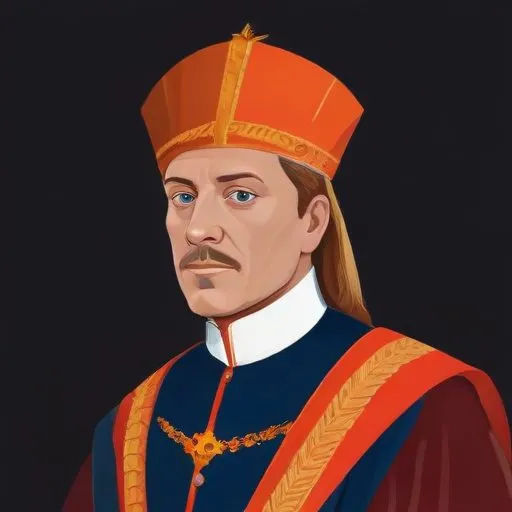
A 13th-century Italian nobleman who ruled Montferrat and led several military campaigns, including the Fifth Crusade. He's also known for his diplomatic efforts to unite the Latin Empire with the Byzantine Empire.
John II, also known as John II Palaeologus, was a 14th-century margrave of Montferrat, a region in northwest Italy. He is renowned for his exceptional military prowess and strategic alliances, which enabled him to expand the boundaries of his margraviate against his neighbors.
Born on February 5, 1321, John II was the son of Theodore I of Montferrat, with whom he was associated in the government from 1336. He demonstrated his leadership skills at a young age, playing a crucial role in extending the boundaries of Montferrat.
In 1338, John was named governor of Asti, marking the beginning of his illustrious career. He capitalized on the power vacuum created by the death of Robert, King of Naples, and the subsequent takeover by his young granddaughter Joanna I. Seizing the opportunity, John expanded his control in northern Italy, conquering key cities such as Alessandria, Asti, Tortona, Bra, and Alba.
One of John's most notable victories was at the Battle of Gamenario in 1345, where he defeated the Angevine vicar Reforza d'Angoult, who lost his life in the battle. This triumph cemented John's position as a formidable leader in the region. He also formed strategic alliances, including one with Luchino Visconti, which further solidified his grip on power.
In 1355, John accompanied Emperor Charles IV through Italy, receiving the cities of Cherasco, Novara, and Pavia as a token of appreciation. However, his marriage to Isabella, the last titular Queen of Majorca, led to a rift with the emperor and subsequent attacks from imperial and Visconti troops. This conflict ultimately resulted in the restitution of territory around Pavia occupied by John to the Visconti in exchange for Visconti possessions in the area of Asti.
John II's will, composed in 1372, appointed Otto of Brunswick and Amadeus VI of Savoy as the guardians of his children. He had four sons, three of whom succeeded him in turn, and a daughter with his wife Isabella. His children included Secondotto, John III, Theodore II, Margaret, and William. John II passed away at Volpiano near Turin and was buried at Chivasso.
Throughout his life, John II demonstrated exceptional leadership skills, forming strategic alliances and expanding his territory through military conquests. His legacy as the Margrave of Montferrat continues to be remembered to this day.
