


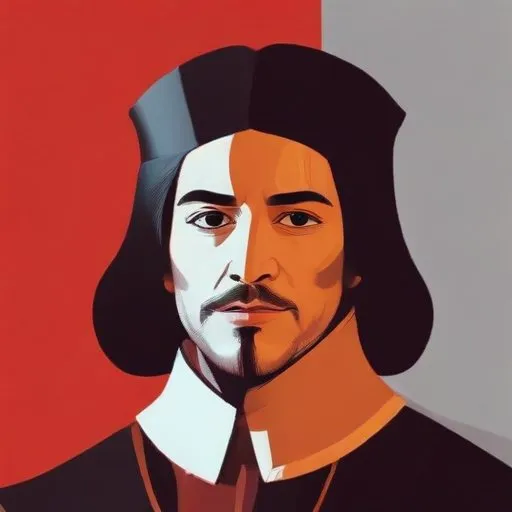
The last king of the Polish-Lithuanian Commonwealth, who fought to preserve his country's independence and unity, and is remembered for his bravery and diplomatic efforts.
Known for his unwavering spirit and unrelenting determination, John II Casimir Vasa was the King of Poland and Grand Duke of Lithuania from 1648 to 1668, as well as a claimant to the throne of Sweden from 1648 to 1660. Born on March 22, 1609, John Casimir Vasa was a force to be reckoned with, navigating the tumultuous landscape of 17th-century European politics with finesse and poise.
As the first son of Sigismund III Vasa and his second wife, Constance of Austria, John Casimir was destined for greatness. In 1638, he embarked on a journey to Spain to negotiate a league with Philip IV against France, but was captured by Cardinal Richelieu and imprisoned at Vincennes for two years. This experience would shape his future as a leader, as he learned to adapt to adversity and navigate complex political alliances.
After his release, John Casimir traveled extensively throughout western Europe, immersing himself in the cultures and customs of the continent. In 1643, he entered the order of Jesuits in Rome, where he was made cardinal by Innocent X. However, he would later renounce his clerical duties and return to Poland to claim his rightful place as king.
John Casimir's reign commenced in 1648, amidst the chaos and destruction caused by the great revolt of the Cossacks under Bohdan Khmelnytsky in Ukraine. The power of the king had been stripped of almost all its prerogatives by the growing influence of the nobles, making his task as ruler even more daunting.
The Tsardom of Russia and Sweden, longtime enemies of Poland, renewed their attacks, and George II Rakoczy of Transylvania invaded Polish territory. The Sejm, Poland's parliament, was continuously dissolved due to the abuse of the liberum veto law, further complicating John Casimir's ability to govern effectively.
In 1655, Charles X Gustav of Sweden triumphantly marched through Poland, occupying Kraków and forcing John Casimir to flee to Silesia. However, the Swedes were eventually stopped by Stefan Czarniecki under Czestochowa, securing a temporary reprieve for the Polish monarchy.
The wars against the Swedes and Russians were terminated by treaties involving significant cessions of provinces on the Baltic and the Dnieper. Poland also lost its sway over the Cossacks, who placed themselves under the protection of the Russian Tsar. This period marked a significant shift in the balance of power in Eastern Europe, with Poland's influence waning and Russia's rising.
John Casimir's legacy is complex and multifaceted, marked by both triumph and defeat. Despite the challenges he faced, he remained committed to his country and his people, earning the respect of his contemporaries and cementing his place in Polish history.
John II Casimir Vasa's remarkable story serves as a testament to his unwavering determination and resilience in the face of adversity. His reign, though marked by turmoil and struggle, remains an indelible part of Poland's rich history, a testament to the country's unyielding spirit and its people's capacity to persevere in the face of overwhelming odds.
Born in 1566
The Polish and Swedish monarch who ruled from 1587 to 1632, known for his attempts to restore Catholicism in Sweden and his involvement in the Polish-Lithuanian Commonwealth's Golden Age. He played a significant role in shaping the fate of Eastern Europe during the 17th century.
Born in 1595
The Polish king who ruled from 1632 to 1648, known for his military campaigns and cultural achievements, including the establishment of the first Polish opera house. He was a strong leader who promoted arts and education.
Born in 1640
The King of Poland who ruled from 1669 to 1673, known for his short but tumultuous reign marked by wars with the Ottoman Empire and internal power struggles.
Born in 1629
The Polish-Lithuanian king who led the Polish-Lithuanian Commonwealth to victory against the Ottoman Empire in the Battle of Vienna in 1683, saving Europe from Ottoman conquest. He's also known for his military prowess and cultural achievements.
Born in 1670
A powerful Polish king who transformed his country into a major European power through military conquests and cultural achievements, earning him the nickname "the Strong".
