


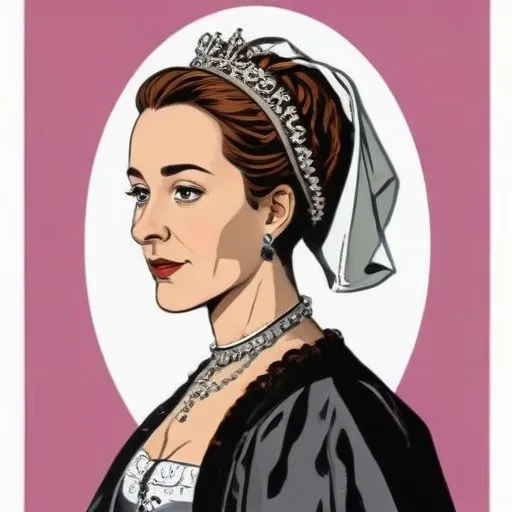
A Habsburg archduchess who played a crucial role in the Thirty Years' War, marrying Polish King Sigismund III and becoming Queen of Poland and Sweden. She was a skilled diplomat and strategist.
Constance of Austria, also known as Konstancja of Poland, was a significant figure in Polish history, serving as the Queen of Poland from 1605 until her death in 1631. As the second wife of King Sigismund III Vasa, she played a crucial role in shaping the country's politics, culture, and architecture.
Born on December 24, 1588, Constance was the daughter of Charles II of Austria and Maria Anna of Bavaria. Her paternal grandparents were Ferdinand I, Holy Roman Emperor, and Anna of Bohemia and Hungary. Through her family ties, Constance was connected to some of the most influential royal houses in Europe.
After the death of her sister, Anna, in 1598, Constance married King Sigismund III Vasa in 1605, becoming the Queen of Poland. She quickly established herself as a shrewd politician, using her charm and intelligence to build a powerful faction of followers. By arranging strategic marriages between her handmaidens and influential nobles, Constance secured a strong network of allies and gained significant control over the country's politics.
As a devoted member of the Habsburg family, Constance worked tirelessly to promote their interests in Poland. She played a crucial role in shaping the country's governance, influencing key appointments in the court, government, and church. Her closest confidant, Urszula Meyerin, was a trusted advisor who shared her passion for politics and diplomacy.
Constance was a patron of the arts, supporting numerous clerics, painters, and architects. Her love for architecture led her to finance the construction of several palaces for her children, showcasing her refined taste and cultural sophistication. Despite her love for luxury, Constance was known for her frugal nature, earning her a reputation as a shrewd manager of the royal finances.
In 1623, Constance sparked controversy by purchasing the town of Żywiec from Mikołaj Komorowski, a move that was prohibited by law for members of the royal family. This decision led to tensions with the Polish Parliament, highlighting the challenges she faced as a foreign-born queen in a male-dominated society.
Additionally, Constance's decree in 1626, which forbade Jews from settling in Żywiec, remains a contentious issue to this day. While her motivations behind this decision are still debated, it is clear that Constance played a significant role in shaping the country's social and cultural landscape.
Constance of Austria's remarkable life and reign have left an indelible mark on Polish history. As a powerful queen, diplomat, and patron of the arts, she navigated the complexities of royal politics with ease and finesse. Her influence extended far beyond the palace walls, shaping the country's culture, architecture, and governance in profound ways.
Through her marriage to King Sigismund III Vasa, Constance secured the succession of her son, John II Casimir, to the throne, ensuring the continuation of the Vasa dynasty. Her legacy serves as a testament to the enduring power and influence of women in politics, even in a time when they often held limited roles.
Born in 1793
Emperor of Austria from 1835 to 1848, known for his role in the Revolutions of 1848 and his abdication in favor of his nephew Franz Joseph.
Born in 1500
Ruling over a vast empire from 1519 to 1556, he was a powerful and influential leader who played a crucial role in shaping European politics and religion. He is most known for his efforts to unify Christian Europe and defend it against the Ottoman Empire.
Born in 1459
First Holy Roman Emperor to rule simultaneously as King of the Romans and King of Spain, known for uniting fragmented German states and establishing the Habsburg dynasty.
Born in 1557
A 16th-century Holy Roman Emperor who ruled over a vast territory, known for his diplomatic and military prowess in maintaining peace and stability during a tumultuous era.
Born in 1559
Governor of the Low Countries, overseeing the region's politics and economy during the Dutch Revolt, while also being a key figure in the Habsburg dynasty. He's known for his diplomatic efforts to maintain peace and unity in the region.
Born in 1503
The first Habsburg to rule the Holy Roman Empire, he unified Austria and introduced the concept of a hereditary monarchy, shaping European politics for centuries to come.
Born in 1606
The Infanta of Spain who married Ferdinand I of Austria, becoming Empress of Austria and Queen of Hungary and Bohemia, and played a significant role in shaping the Habsburg dynasty.
