


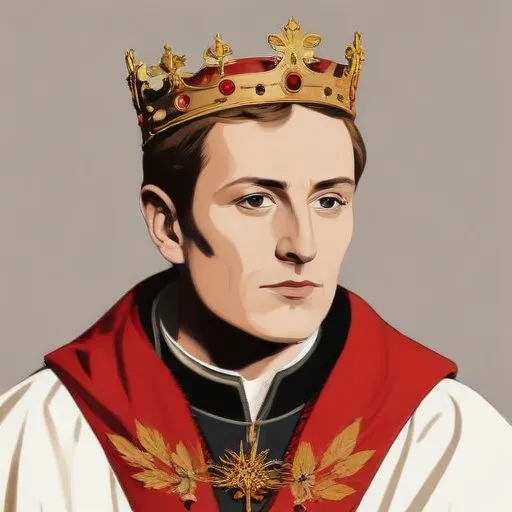
A 16th-century Holy Roman Emperor who ruled over a vast territory, known for his diplomatic and military prowess in maintaining peace and stability during a tumultuous era.
Matthias, Holy Roman Emperor, is remembered for his pivotal role in shaping the fate of the Habsburg dynasty and the tumultuous era of the Thirty Years' War. From 1612 to 1619, he reigned as the Holy Roman Emperor, Archduke of Austria, King of Hungary and Croatia, and King of Bohemia, leaving an indelible mark on European history.
Born on February 24, 1557, in Vienna, Matthias was the fourth son of Maximilian II, Holy Roman Emperor, and Maria of Spain. His family was a veritable who's who of European royalty, with his brothers including Rudolf, who would become Emperor Rudolf II, and his sisters marrying into the royal families of Spain and France.
Little is known about Matthias' upbringing, but one of his teachers was the celebrated writer and historian Ogier Ghislain de Busbecq. Upon his father's death, Matthias' eldest brother Rudolf inherited the family's estates and property, while Matthias and his other brothers received cash pensions and appointments to church or state positions.
Matthias' marriage to Archduchess Anna of Austria, daughter of his uncle Archduke Ferdinand II of Austria, in 1595 paved the way for his rise to power. He became his uncle's heir in Further Austria and eventually played a significant role in the familial opposition against his brother Emperor Rudolf II.
Matthias' personal motto, "Concordia lumine maior" or "Unity is stronger in the light," reflected his desire to bring harmony to the fractured Habsburg dynasty and the tumultuous landscape of Europe. Despite his efforts, his reign was marked by controversy and strife, particularly in the final year of his reign, which saw the outbreak of the Bohemian Revolt, the initial theatre of the Thirty Years' War.
Matthias' politics were largely determined by Cardinal Melchior Klesl until his fall in 1618. His failed religious and administrative policies contributed to the growing unrest in Bohemia, which ultimately led to the revolt that would engulf Europe in conflict.
Matthias' reign marked a turning point in European history, as the continent teetered on the brink of war and instability. His legacy is a complex one, characterized by both his attempts to unify the Habsburg dynasty and the strife that ultimately led to the Thirty Years' War.
Despite his flaws, Matthias remains an important figure in the annals of European history, a testament to the complexities and challenges of ruling a fractured and tumultuous continent.
Born in 1503
The first Habsburg to rule the Holy Roman Empire, he unified Austria and introduced the concept of a hereditary monarchy, shaping European politics for centuries to come.
Born in 1459
First Holy Roman Emperor to rule simultaneously as King of the Romans and King of Spain, known for uniting fragmented German states and establishing the Habsburg dynasty.
Born in 1500
Ruling over a vast empire from 1519 to 1556, he was a powerful and influential leader who played a crucial role in shaping European politics and religion. He is most known for his efforts to unify Christian Europe and defend it against the Ottoman Empire.
Born in 1503
The first Habsburg to rule the Holy Roman Empire, he unified Austria and introduced the concept of a hereditary monarchy, shaping European politics for centuries to come.
Born in 1397
King of the Romans and Duke of Austria, known for his brief reign and attempts to unify the German states. He was a member of the Habsburg dynasty and played a significant role in European politics during the 14th century.
Born in 1747
The last Habsburg ruler to hold the title of Holy Roman Emperor, he oversaw the dissolution of the empire and played a key role in European politics during the French Revolution.
