


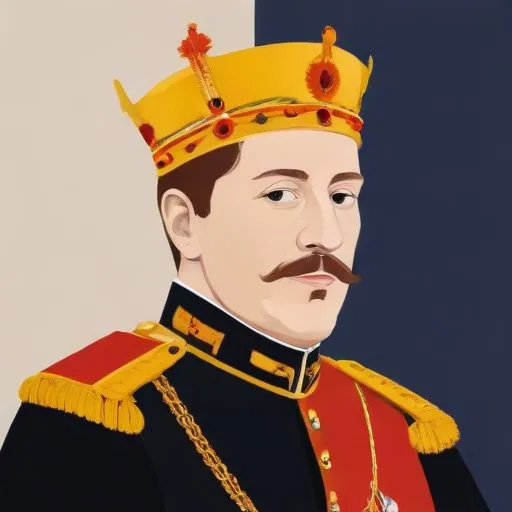
Holy Roman Emperor who ruled from 1564 to 1576, known for his efforts to reform the Catholic Church and his role in the Council of Trent.
As the Holy Roman Emperor from 1564 to 1576, Maximilian II left an indelible mark on European history, earning himself the sobriquet "the Pacific Emperor". He was the first Habsburg ruler to be crowned King of Bohemia, King of Germany, and King of Hungary, simultaneously, a testament to hisvision of a unified empire.
Born in Vienna, Austria, on July 31, 1527, Maximilian was the eldest son of King Ferdinand I and Princess Anne of Bohemia and Hungary. His early life was shaped by the intrigues of Habsburg politics, as his father expanded the monarchy through strategic marriages and alliances. Maximilian's education, primarily in Italy, was steeped in humanism, with scholars like Kaspar Ursinus Velius and Georg Tannstetter influencing his worldview.
During Maximilian's reign, the confessionalization process following the 1555 Peace of Augsburg created deep divisions within the empire. While a devout Catholic, he sought to bridge the gap between Catholic and Lutheran factions, striving for a unified Christianity. This tolerance earned him both admiration and criticism, as he navigated the treacherous landscape of religious politics.
Maximilian's love for the arts and sciences was evident in his patronage of renowned artists, architects, and scholars. His court attracted luminaries like the astronomer Tycho Brahe, and the architects Bonino and Ferrabosco, who designed the magnificent Hofburg Palace in Vienna. His support for the arts and education helped to foster a flourishing cultural scene in the empire.
The ongoing Ottoman-Habsburg wars posed a significant threat to the empire's borders and stability. Maximilian, aware of the Imperium's vulnerabilities, sought to strengthen alliances and forge peace treaties with his Spanish Habsburg cousins. Though his efforts ultimately failed, his diplomatic efforts to contain the Ottoman Empire's expansion demonstrate his commitment to protecting the empire's territorial integrity.
While Maximilian's reign was marked by challenges and controversy, his commitment to cultural patronage, religious tolerance, and diplomacy have ensured his place in history as a statesman and a patron of the arts. His legacy, though complex, testifies to the enduring power of visionary leadership in shaping the course of human events.
Maximilian II's story serves as a testament to the complexities of power, politics, and vision in shaping the fate of empires. As a ruler who navigated the treacherous waters of religious and territorial conflicts, his legacy continues to inspire and educate, offering valuable lessons for generations to come.
Born in 1500
Ruling over a vast empire from 1519 to 1556, he was a powerful and influential leader who played a crucial role in shaping European politics and religion. He is most known for his efforts to unify Christian Europe and defend it against the Ottoman Empire.
Born in 1503
The first Habsburg to rule the Holy Roman Empire, he unified Austria and introduced the concept of a hereditary monarchy, shaping European politics for centuries to come.
Born in 1557
A 16th-century Holy Roman Emperor who ruled over a vast territory, known for his diplomatic and military prowess in maintaining peace and stability during a tumultuous era.
Born in 1503
The first Habsburg to rule the Holy Roman Empire, he unified Austria and introduced the concept of a hereditary monarchy, shaping European politics for centuries to come.
Born in 1578
Ruling Spain from 1598 to 1621, he oversaw the country's peak of power and cultural flourishing, while also facing challenges from the Thirty Years' War and the Inquisition.
Born in 1747
The last Habsburg ruler to hold the title of Holy Roman Emperor, he oversaw the dissolution of the empire and played a key role in European politics during the French Revolution.
Born in 1768
The last Holy Roman Emperor, who ruled from 1792 to 1806, oversaw the dissolution of the Holy Roman Empire and was a key figure in European politics during the Napoleonic Wars.
