


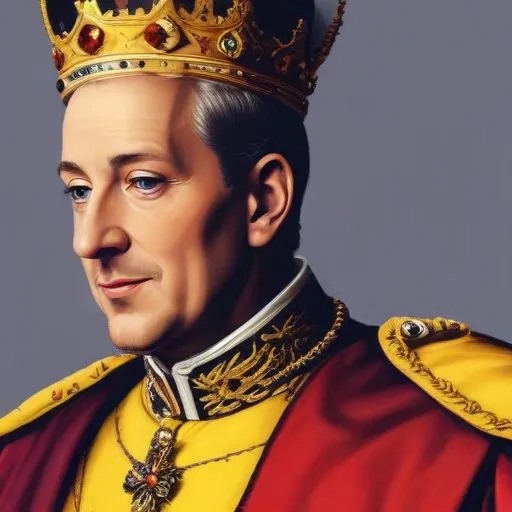
The last Holy Roman Emperor, who ruled from 1792 to 1806, oversaw the dissolution of the Holy Roman Empire and was a key figure in European politics during the Napoleonic Wars.
Francis II, Holy Roman Emperor, was the last ruler of the Holy Roman Empire, which he reigned over from 1792 to 1806. He is also remembered as the first Emperor of Austria, a title he held from 1804 to 1835, and King of Hungary, Croatia, and Bohemia, cementing his position as a prominent figure in European history.
Born on February 12, 1768, in Florence, Italy, Francis was the eldest son of Leopold II, Holy Roman Emperor, and Maria Luisa of Spain. Following his father's death in 1790, Francis succeeded him as Holy Roman Emperor, taking on the mantle of leadership at the tender age of 22.
Francis' reign was marred by the French Revolutionary Wars, which began in 1792 and continued for over two decades. The wars saw France, under the leadership of Napoleon Bonaparte, rise to dominance in Europe, and Francis' empire suffered a series of defeats, including the loss of the left bank of the Rhine to France.
In response to Napoleon's coronation as Emperor of the French in 1804, Francis assumed the title of Emperor of Austria, marking a significant shift in the balance of power in Europe.
The Napoleonic Wars, which began in 1803, saw Francis' empire suffer further defeats, and in 1806, he was forced to abdicate as Holy Roman Emperor, effectively dissolving the Holy Roman Empire.
Francis ceded more territory to France and was forced to marry his daughter, Marie Louise, to Napoleon in an attempt to secure an alliance.
In 1813, Francis turned against Napoleon and eventually defeated him in the War of the Sixth Coalition, leading to the French emperor's abdication.
The Congress of Vienna, which followed, was dominated by Francis' chancellor, Klemens von Metternich, and saw the restoration of most of Francis' ancient dominions, marking a new era in European politics.
Francis died on March 2, 1835, leaving behind a complex legacy. Viewed by some as a reactionary, Francis' later reign was marked by his attempts to resist popular nationalist and liberal tendencies.
Despite this, he remains an important figure in European history, and his reign marked a significant turning point in the evolution of the continent's politics.
Francis married four times, first to Elisabeth of Württemberg, then to Maria Theresa of Naples and Sicily, followed by Maria Ludovika of Austria-Este, and finally to Caroline Augusta of Bavaria.
He had 12 children, including Marie Louise, who married Napoleon, and Franz Karl, who would go on to become the father of Franz Joseph, the future Emperor of Austria.
Francis' reign marked the end of the Holy Roman Empire, a significant institution that had shaped European politics for centuries. His legacy is complex, marked by both his resistance to change and his ability to adapt to new circumstances.
Today, Francis is remembered as a key figure in European history, whose reign marked a significant turning point in the continent's development.
Born in 1769
A French military leader who rose to prominence during the French Revolution and became Emperor of France, known for his military conquests and reorganization of Europe. He is also famous for his Napoleonic Code, which remains a foundation of modern law.
Born in 1755
The last queen of France before the French Revolution, known for her extravagance and mismanagement of the French economy, which contributed to the downfall of the monarchy.
Born in 1710
The monarch who ruled France from 1715 to 1774, known as the "Sun King's" great-grandson, and remembered for his extravagance, absolutism, and the decline of the French monarchy.
Born in 1741
Reformer of the Habsburg dominions, abolishing serfdom and promoting religious tolerance, who implemented numerous reforms to modernize his empire.
Born in 1747
The last Habsburg ruler to hold the title of Holy Roman Emperor, he oversaw the dissolution of the empire and played a key role in European politics during the French Revolution.
Born in 1717
The wife of Francis I, Holy Roman Emperor, ruled Austria and its territories with intelligence and diplomacy, implementing reforms and expanding the empire through strategic marriages. She's remembered for her strong leadership and cultural achievements.
Born in 1712
Prussian king who ruled with Enlightenment values, promoting arts, education, and religious tolerance, while also being a skilled military strategist and expanding his kingdom through wars.
Born in 1729
Empress of Russia from 1762 to 1796, she transformed her country into a major European power, modernizing its culture, politics, and economy through numerous reforms and conquests.
