


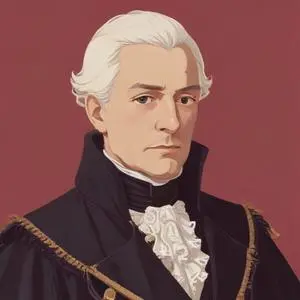
Prussian king who ruled with Enlightenment values, promoting arts, education, and religious tolerance, while also being a skilled military strategist and expanding his kingdom through wars.
Frederick the Great: The Enlightened Monarch of Prussia

Frederick the Great, also known as Friedrich der Große, is renowned for his remarkable military conquests, enlightened absolutism, and patronage of the arts and enlightenment. He is celebrated as one of the most influential monarchs in Prussian history, ruling from 1740 until 1786 and transforming Prussia into a major military power in Europe.

Military Conquests and Legacy

Frederick's military successes in the Silesian Wars earned him great acclaim, and his reorganisation of the Prussian Army made it one of the most formidable forces in Europe. He annexed the rich Austrian province of Silesia in 1742, which became a significant addition to Prussia's territories. His military theories, shaped by his extensive personal battlefield experience, covered issues of strategy, tactics, mobility, and logistics, and remain influential to this day.

Enlightened Absolutism and Governance

Frederick was a staunch supporter of enlightened absolutism, believing that the ruler should be the first servant of the state. He modernised the Prussian bureaucracy and civil service, making it possible for men of lower status to become judges and senior bureaucrats. He also reformed the judicial system, ensuring a greater degree of fairness and equality.

Patronage of the Arts and Enlightenment

Frederick was a passionate patron of the arts and enlightenment. He attracted prominent intellectuals, such as Voltaire and Immanuel Kant, to his court, and his support for the arts led to a flourishing cultural scene in Prussia. He encouraged freedom of the press and literature, and his tolerance for religious diversity made Prussia a haven for immigrants of diverse backgrounds.

Personal Milestones and Key Life Events
Frederick's philosophical outlook was shaped by his fascination with the Enlightenment. He believed in the power of reason and the importance of education, and his support for prominent thinkers and writers reflected his commitment to intellectual freedom and inquiry.
Frederick's legacy extends far beyond his own lifetime. His military reforms, administrative innovations, and cultural patronage have had a lasting impact on European history, shaping the development of modern nation-states and the course of Western civilization.
Despite his many achievements, Frederick's reign was not without controversy. His treatment of religious minorities, particularly Jews and Catholics, was often marked by prejudice, and his military conquests were often accompanied by violence and displacement. However, his efforts to modernise and reform Prussia have largely overshadowed these criticisms, cementing his reputation as one of history's greatest monarchs.
Born in 1694
A witty and insightful 18th-century writer and philosopher who used satire to critique societal norms and advocate for reason, tolerance, and human rights.
Born in 1724
Developed influential philosophical frameworks, such as the Critique of Pure Reason, that shaped modern Western thought on ethics, morality, and human understanding.
Born in 1729
Empress of Russia from 1762 to 1796, she transformed her country into a major European power, modernizing its culture, politics, and economy through numerous reforms and conquests.
