


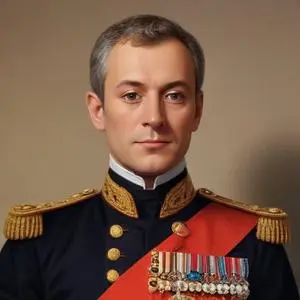
The 1st State Chancellor of the Austrian Empire, a master diplomat and strategist who maintained European peace and balance of power through clever alliances and negotiations, shaping the continent's politics for decades.
Klemens von Metternich, a German-Austrian statesman and diplomat, is renowned for his pivotal role in shaping the European balance of power during the 19th century. As the Austrian Empire's foreign minister and chancellor, he orchestrated a complex web of alliances and diplomatic maneuvers that maintained peace and stability in Europe for over three decades.
Metternich was born on May 15, 1773, into the noble House of Metternich in Koblenz, Germany. He received a superior education at the universities of Strasbourg and Mainz, which laid the foundation for his future diplomatic career.
Metternich's diplomatic career began in 1801 as a member of the Austrian delegation to the Congress of Rastatt. He swiftly rose through the ranks, serving as ambassador to the Kingdom of Saxony, Kingdom of Prussia, and eventually Napoleonic France. His notable diplomatic achievements include engineering a détente with France, which led to the marriage of Napoleon to Austrian Archduchess Marie Louise.
As foreign minister, Metternich crafted a system of international congresses that maintained the balance of power in Europe. This system, which came to be known as the Metternich System, ensured that no single nation became too powerful, thereby preventing wars and maintaining stability. The Congress of Vienna, which he led, divided post-Napoleonic Europe among the major powers, solidifying Austria's position as a dominant force.
Metternich's exceptional service to the Austrian Empire earned him the title of Prince in 1813. He continued to serve as Chancellor of State from 1821 to 1848, under both Francis I and his son Ferdinand I.
After a brief exile in London, Brighton, and Brussels, Metternich returned to the Viennese court in 1851, offering advice to Franz Josef, the new emperor. He passed away on June 11, 1859, leaving behind a legacy as one of the most influential diplomats in European history.
Metternich's diplomatic prowess and his system of international congresses set a precedent for modern international relations. His legacy extends beyond Europe, influencing global politics and diplomacy to this day.
Born in 1769
A French military leader who rose to prominence during the French Revolution and became Emperor of France, known for his military conquests and reorganization of Europe. He is also famous for his Napoleonic Code, which remains a foundation of modern law.
Born in 1777
King of the Two Sicilies from 1825 to 1830, known for his attempts to reform the government and economy, but ultimately failing to modernize the kingdom.
Born in 1876
The leader of the Catholic Church from 1939 to 1958, known for his controversial role during World War II, particularly in regards to the Holocaust. He is also remembered for his encyclicals on social justice and liturgical reforms.
