


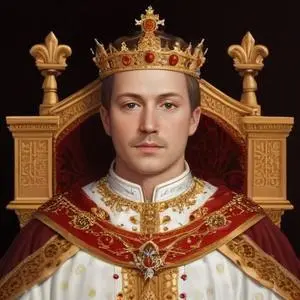
Reformer of the Habsburg dominions, abolishing serfdom and promoting religious tolerance, who implemented numerous reforms to modernize his empire.
Joseph II, Holy Roman Emperor, is remembered as one of the most influential and progressive monarchs of the 18th century, known for his tireless efforts to modernize and secularize the Habsburg Empire. From 1765 to 1790, he ruled with an iron fist, implementing a plethora of reforms that aimed to promote education, arts, and individual liberties, earning him a place among the great Enlightenment monarchs, alongside Catherine the Great of Russia and Frederick the Great of Prussia.
Born on March 13, 1741, Joseph was the eldest son of Empress Maria Theresa and Emperor Francis I, and the brother of Marie Antoinette, Leopold II, Maria Carolina of Austria, and Maria Amalia, Duchess of Parma. His education was shaped by the writings of prominent thinkers, including David Hume, Edward Gibbon, Voltaire, Jean-Jacques Rousseau, and the Encyclopédistes, which instilled in him a strong sense of enlightenment values and a desire for reform.
Joseph II's reign was marked by a flurry of reforms, which aimed to centralize power, reduce the influence of the Catholic Church, and promote education, arts, and individual liberties. Some of his most notable reforms included:
Joseph II was a passionate supporter of the arts, particularly music. He was a patron of renowned composers, such as Wolfgang Amadeus Mozart and Antonio Salieri, and encouraged the development of opera and classical music in Vienna.
Joseph II died on February 20, 1790, without an heir, and was succeeded by his younger brother, Leopold II. Despite facing significant opposition and criticism during his reign, his reforms had a lasting impact on the Habsburg Empire and beyond, shaping the course of modern European history. His commitment to enlightenment values and individual liberties has earned him a place among the greatest monarchs of all time.
Joseph II's philosophical views were deeply rooted in the principles of the Enlightenment, emphasizing reason, individual liberty, and the separation of church and state. He believed in the power of education and the arts to shape a more enlightened and tolerant society.
Joseph II's reign coincided with a period of great upheaval in Europe, marked by the rise of revolutionary ideas and the decline of absolute monarchies. His reforms, although not always successful, paved the way for future generations of reformers and revolutionaries, shaping the course of modern European history.
Joseph II's reign is often compared to that of his contemporaries, Catherine the Great of Russia and Frederick the Great of Prussia, who shared his commitment to enlightenment values and reform. While his reforms were not always successful, they demonstrate a remarkable commitment to progressive ideals and a willingness to challenge established power structures.
Joseph II was known for his simplicity and frugality, often dressing in simple attire and rejecting lavish ceremonies and protocol. He was also a prolific writer, penning numerous letters and treatises on politics, philosophy, and education.
Joseph II's legacy has inspired numerous artistic works, including operas, plays, and films, which often portray him as a visionary and progressive leader. His commitment to the arts and education has also inspired generations of artists, writers, and intellectuals.
Born in 1717
The wife of Francis I, Holy Roman Emperor, ruled Austria and its territories with intelligence and diplomacy, implementing reforms and expanding the empire through strategic marriages. She's remembered for her strong leadership and cultural achievements.
Born in 1768
The last Holy Roman Emperor, who ruled from 1792 to 1806, oversaw the dissolution of the Holy Roman Empire and was a key figure in European politics during the Napoleonic Wars.
Born in 1747
The last Habsburg ruler to hold the title of Holy Roman Emperor, he oversaw the dissolution of the empire and played a key role in European politics during the French Revolution.
Born in 1729
Empress of Russia from 1762 to 1796, she transformed her country into a major European power, modernizing its culture, politics, and economy through numerous reforms and conquests.
Born in 1712
Prussian king who ruled with Enlightenment values, promoting arts, education, and religious tolerance, while also being a skilled military strategist and expanding his kingdom through wars.
Born in 1694
A witty and insightful 18th-century writer and philosopher who used satire to critique societal norms and advocate for reason, tolerance, and human rights.
Born in 1712
A pioneering thinker who shaped modern democracy and education with his ideas on social contracts, general will, and the importance of early childhood education. His writings influenced the French Revolution and modern political thought.
Born in 1724
Developed influential philosophical frameworks, such as the Critique of Pure Reason, that shaped modern Western thought on ethics, morality, and human understanding.
