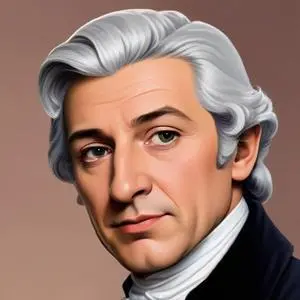
Antonio Salieri: The Maestro Behind the Masquerade
A Pivotal Figure in Opera's Golden Age
Antonio Salieri was a renowned Italian composer and teacher of the classical period, credited with shaping the landscape of late 18th-century opera. With a career spanning over four decades, Salieri dominated the Italian-language opera scene in Vienna, leaving an indelible mark on the world of classical music.
A Cosmopolitan Composer
Born on August 18, 1750, in Legnago, Republic of Venice, Salieri was a student of
Florian Leopold Gassmann and protégé of
Christoph Willibald Gluck. This education exposed him to a wide range of musical influences, which he seamlessly blended into his compositions. Salieri's operas, written in three languages, featured a unique fusion of Italian, French, and German styles, earning him recognition as a cosmopolitan composer.
Director of Italian Opera and Imperial Kapellmeister
In 1774, Salieri was appointed the director of the Italian opera by the Habsburg court, a position he held until 1792. Later, he became the Austrian imperial Kapellmeister, a role that entailed overseeing music at the court chapel and attached school. This dual responsibility allowed Salieri to shape the musical landscape of Vienna, mentoring a new generation of composers and performers.
A Legacy of Influence
Salieri's impact on the musical world was profound. His pupils included some of the most celebrated composers of the time, such as
Franz Liszt,
Franz Schubert,
Ludwig van Beethoven, and
Franz Xaver Wolfgang Mozart. These future luminaries benefited from Salieri's guidance, going on to shape the course of classical music.
Operatic Works and Revival
Salieri's extensive catalog of operas, including
Tarare,
Les Danaïdes, and
Armida, were widely performed throughout Europe during his lifetime. Although his works fell out of favor in the 19th century, a 20th-century revival, sparked by
Peter Shaffer's play
Amadeus (1979) and its film adaptation (1984), reintroduced Salieri's music to a new audience.
Rumors and Rivalries
The demise of
Wolfgang Amadeus Mozart in 1791 at the age of 35 led to speculation about a supposed rivalry between the two composers. The rumor, later perpetuated by Shaffer's play, suggested that Salieri had poisoned Mozart. However, this claim has been largely discredited by historians.
Personal Milestones and Key Life Events
- 1750: Born in Legnago, Republic of Venice
- 1766: Began studying music with Florian Leopold Gassmann
- 1774: Appointed director of the Italian opera by the Habsburg court
- 1788: Became the Austrian imperial Kapellmeister
- 1792: Stepped down as director of the Italian opera
- 1804: Last opera composition, Die Negerin
- 1825: Passed away on May 7, in Vienna
Historical Context and Legacy
Salieri's life and works are a testament to the rich cultural heritage of 18th-century Europe. As a composer, teacher, and mentor, he played a pivotal role in shaping the classical music landscape. Today, his music continues to inspire new generations of musicians and music lovers alike.
FAQ
What was Antonio Salieris role in the development of opera?
Antonio Salieri was a prominent Italian composer and conductor who played a significant role in the development of opera. He was a prolific composer, and his works include several operas, as well as sacred music and chamber music.
What is Antonio Salieris most famous opera?
Antonio Salieris most famous opera is Tarare, which was first performed in 1787. It is a comic opera that tells the story of a group of characters who become embroiled in a complicated web of love and deception.
How did Antonio Salieris rivalry with Mozart shape his career?
Antonio Salieris rivalry with Wolfgang Amadeus Mozart had a significant impact on his career, as it led to a series of public feuds and controversies. Despite this, Salieri continued to compose and teach, and he went on to become one of the most prominent musicians of his time.
What was Antonio Salieris teaching style and legacy?
Antonio Salieri was a renowned teacher, and his students included several prominent composers, including Ludwig van Beethoven and Franz Liszt. His teaching style emphasized the importance of technical skill and musicality, and he is remembered as one of the most influential music teachers of his time.
What is Antonio Salieris legacy in modern times?
Antonio Salieris legacy in modern times is as a significant figure in the development of opera and classical music. His compositions continue to be performed and admired, and he is remembered as a talented and influential musician who played a key role in shaping the course of musical history.