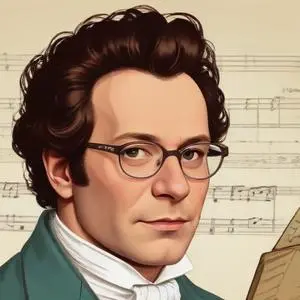
Franz Schubert: The Visionary Composer of the Early Romantic Era
A Life Cut Short, a Legacy that Transcends Time
Franz Schubert is renowned for his profound contributions to classical music, leaving behind an impressive oeuvre of over 600 secular vocal works, seven complete symphonies, sacred music, operas, incidental music, and a vast array of piano and chamber music. Despite his short life, Schubert's innovations and masterpieces have cemented his position as one of the most important figures in the transition between the Classical and Romantic eras.
A Childhood Steeped in Music
Born on January 31, 1797, in the Himmelpfortgrund suburb of Vienna, Schubert demonstrated an extraordinary talent for music from an early age. His father, a schoolteacher, and his elder brother provided him with his first violin and piano lessons, respectively. However, it wasn't long before Schubert's prodigious abilities surpassed those of his instructors.
Formative Years and Inspirations
In 1808, at the age of eleven, Schubert became a pupil at the Stadtkonvikt school, where he was exposed to the orchestral music of
Joseph Haydn,
Wolfgang Amadeus Mozart, and
Ludwig van Beethoven. This exposure had a profound impact on his development as a composer, shaping his unique style and inspiring his creative genius. During this period, he also began studying composition with
Antonio Salieri, who recognized and fostered Schubert's exceptional talent.
A Prolific Career and Iconic Works
Schubert's compositional output was staggering, with iconic works that include:
- Erlkönig, a haunting and expressive art song that showcases his mastery of vocal music
- Gretchen am Spinnrade, a poignant and introspective song that highlights his ability to evoke drama and emotion
- Ave Maria, a sublime and enduring work that has become a cultural touchstone
- The Trout Quintet, a delightful and masterful work that blends virtuosity with lyricism
- The Unfinished Symphony (Symphony No. 8 in B minor), a majestic and enigmatic work that has captivated audiences for centuries
- The Great C major Symphony (Symphony No. 9), a monumental and triumphant work that showcases his mastery of symphonic form
A Legacy that Transcends Time
Schubert's influence on modern society is profound, with his music continuing to inspire and influence generations of composers, musicians, and music lovers. His innovations in harmony, melody, and form have reshaped the classical music landscape, paving the way for the Romantic era and beyond. His legacy extends beyond the concert hall, with his music appearing in films, literature, and popular culture.
Personal Milestones and Key Life Events
Schubert's life was marked by significant milestones, including his acceptance as a performing member of the Gesellschaft der Musikfreunde in 1821, which helped establish his reputation among the Viennese elite. In March 1828, he gave a concert of his works to critical acclaim, the only time he did so in his career. Tragically, Schubert passed away on November 19, 1828, at the age of 31, leaving behind a body of work that would continue to inspire and influence generations to come.
Inspirational Stories and Motivations
Schubert's life and legacy serve as a testament to the power of creative vision and innovation. Despite facing personal struggles and setbacks, he remained committed to his art, driven by an unwavering passion and dedication. His story continues to inspire and motivate artists, musicians, and music lovers, reminding us of the transformative power of music to touch hearts, minds, and souls.
FAQ
What was Franz Schuberts contribution to classical music?
Franz Schubert was an Austrian pianist and composer who made significant contributions to classical music, including symphonies, operas, and chamber music.
What was Franz Schuberts most famous work?
Franz Schuberts most famous work is his Unfinished Symphony, a renowned masterpiece that showcases his innovative and expressive style.
How did Franz Schuberts music reflect his personal life?
Franz Schuberts music reflected his personal life, marked by struggles with poverty, illness, and personal relationships, which he expressed through his emotive and introspective compositions.
What was Franz Schuberts role in the development of Romantic music?
Franz Schubert played a key role in the development of Romantic music, helping to shape the genre through his innovative use of harmony, melody, and form.
What is Franz Schuberts legacy in music history?
Franz Schuberts legacy in music history is that of a visionary composer who expanded the possibilities of classical music and paved the way for future generations of musicians.