


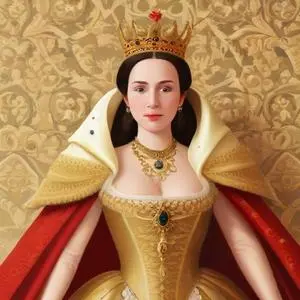
The wife of Francis I, Holy Roman Emperor, ruled Austria and its territories with intelligence and diplomacy, implementing reforms and expanding the empire through strategic marriages. She's remembered for her strong leadership and cultural achievements.
Maria Theresa, a name synonymous with power, diplomacy, and strategic leadership, was the sole female ruler of the Habsburg dominions, reigning for an impressive 40 years from 1740 until her death in 1780. She was the sovereign of a vast empire, encompassing Austria, Hungary, Croatia, Bohemia, Transylvania, Mantua, Milan, Galicia, and Lodomeria, the Austrian Netherlands, and Parma, making her one of the most powerful women in European history.
Maria Theresa was born on May 13, 1717, to Emperor Charles VI and Empress Elisabeth Christine of Brunswick-Wolfenbüttel. Her father, eager to secure her succession, issued the Pragmatic Sanction of 1713, which allowed a female heir to inherit the throne. Despite this, Maria Theresa's accession was not without its challenges. Upon her father's death in 1740, she faced opposition from neighboring powers, including Saxony, Prussia, Bavaria, and France, which repudiated the Pragmatic Sanction.
Faced with the daunting task of defending her inherited territories, Maria Theresa showed remarkable diplomatic and military acumen. Frederick II of Prussia, her greatest rival, invaded Silesia, a prosperous Habsburg province, sparking the War of the Austrian Succession. Undeterred, Maria Theresa secured the crucial support of the Hungarians, eventually defending her rule over most of the Habsburg monarchy, despite losing Silesia and minor Italian territories.
Maria Theresa's reign was marked by a series of strategic alliances and diplomatic maneuvers. She navigated the complex web of European politics, often walking a tightrope between rival powers. Her marriage to Francis I, Duke of Lorraine, secured an important alliance, while her relationship with her son, Emperor Joseph II, was more complicated, with both ruling alongside her as co-rulers in Austria and Bohemia.
Maria Theresa implemented significant domestic reforms, modernizing the Habsburg system of government, promoting education, and encouraging the arts. Her reign saw the establishment of the Austria's first state-sponsored educational institutions, as well as the creation of the Vienna State Opera. Her progressive policies earned her the respect and admiration of her subjects, cementing her legacy as a wise and just ruler.
Maria Theresa was a devoted wife and mother, giving birth to 16 children, including 10 daughters and 6 sons. Her family life was marked by tragedy, with the death of her eldest son, Joseph, in 1765. Despite personal struggles, she remained committed to her duties as a ruler, earning the nickname "the Great" for her unwavering dedication to her people.
Maria Theresa's reign occurred during a time of significant upheaval in European history, with the rise of Prussia, the decline of the Ottoman Empire, and the precursor to the French Revolution. Despite these challenges, she successfully navigated her empire through treacherous waters, leaving behind a lasting legacy as one of the most influential women in history.
Maria Theresa's contemporaries included notable figures such as Frederick II of Prussia, Catherine the Great of Russia, and Louis XV of France. While each had their own distinct leadership styles, Maria Theresa's unique blend of diplomacy, strategic thinking, and devotion to her people set her apart as a true stateswoman.
Maria Theresa's remarkable life serves as an inspiration to women and leaders around the world. Her determination to protect her people, her commitment to education and the arts, and her unwavering dedication to her duties as a ruler make her an enduring symbol of female empowerment and leadership.
In conclusion, Maria Theresa was a trailblazing leader, whose remarkable reign continues to inspire and captivate us today. Her extraordinary life, marked by diplomacy, strategic thinking, and devotion to her people, cements her place as one of the most influential women in history.
44 Years Old
A Cameroonian professional footballer who played as a midfielder and won several titles with clubs in Europe and Africa. He's known for his skillful playing style and goal-scoring ability.
Born in 1755
The last queen of France before the French Revolution, known for her extravagance and mismanagement of the French economy, which contributed to the downfall of the monarchy.
Born in 1462
The king who ruled France from 1498 to 1515, known for his military campaigns in Italy and his role in the Italian Wars, which shaped the country's foreign policy.
Born in 1729
Empress of Russia from 1762 to 1796, she transformed her country into a major European power, modernizing its culture, politics, and economy through numerous reforms and conquests.
Born in 1712
Prussian king who ruled with Enlightenment values, promoting arts, education, and religious tolerance, while also being a skilled military strategist and expanding his kingdom through wars.
Born in 1694
A witty and insightful 18th-century writer and philosopher who used satire to critique societal norms and advocate for reason, tolerance, and human rights.
