


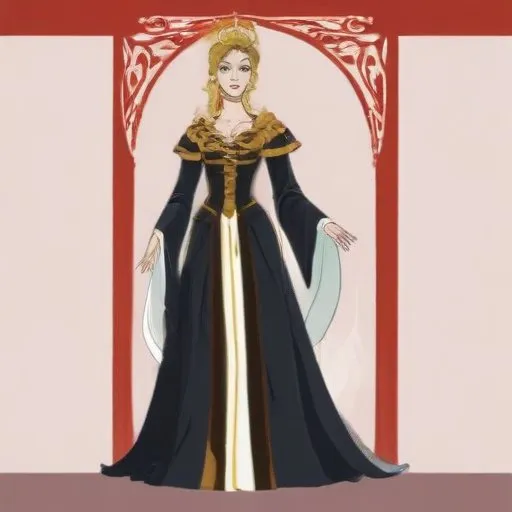
The wife of Charles VI, Holy Roman Emperor, and mother of Maria Theresa, she played a crucial role in securing the Habsburg dynasty's power and legacy through her strategic marriages and diplomatic efforts.
Renowned for her delicate beauty and strong maternal instincts, Elisabeth Christine of Brunswick-Wolfenbüttel was the Holy Roman Empress, German Queen, Queen of Bohemia and Hungary, and Archduchess of Austria, leaving an indelible mark on the pages of history.
As the mother of Empress Maria Theresa, one of the most formidable female leaders of her time, Elisabeth Christine's influence extended far beyond her regal titles, shaping the course of European politics and society for generations to come.
Born on August 28, 1691, in Brunswick, Elisabeth Christine was the first child and eldest daughter of Louis Rudolph, Duke of Brunswick-Wolfenbüttel, and his wife, Princess Christine Louise of Oettingen-Oettingen. She had three siblings, Charlotte August, Charlotte Christine, and Antoinette Amalie.
At the tender age of 13, Elisabeth Christine became engaged to the future Charles VI, Holy Roman Emperor, through negotiations between her ambitious grandfather, Anthony Ulrich, Duke of Brunswick-Wolfenbüttel, and Charles' sister-in-law, Empress Wilhelmine Amalia.
Initially, the Lutheran Protestant bride opposed the marriage, which involved her converting to Catholicism. However, after a pilgrimage to Mariazell in 1706 with her mother-in-law, Empress Eleonore, Elisabeth Christine was tutored in Catholicism and eventually gave in to the union.
On May 1, 1707, she was converted in Bamberg, Germany, and required to swear the Tridentine Creed rather than a modified version she had hoped for. This significant step marked the beginning of her journey as the Empress of the Holy Roman Empire.
Elisabeth Christine's marriage to Charles VI took place in 1708, and she became the longest-serving Holy Roman Empress in history, reigning for over 42 years. During her tenure, she played a crucial role in shaping the empire's policies, often serving as a mediator between her husband and his advisors.
As the mother of Empress Maria Theresa, Elisabeth Christine's maternal instincts and strong character had a profound impact on her daughter's upbringing and eventual ascension to the throne.
Elisabeth Christine's legacy extends beyond her regal titles and family connections. She was a patron of the arts and education, supporting various charitable initiatives and institutions during her reign.
Her influence on modern society is still felt today, with Empress Maria Theresa going on to become one of the most prominent female leaders in European history, ruling for over 40 years and implementing significant reforms in education, politics, and economy.
In conclusion, Elisabeth Christine of Brunswick-Wolfenbüttel was a remarkable woman who left an indelible mark on history, shaping the course of European politics and society through her marriage, motherhood, and patronage of the arts and education.
Born in 1500
Ruling over a vast empire from 1519 to 1556, he was a powerful and influential leader who played a crucial role in shaping European politics and religion. He is most known for his efforts to unify Christian Europe and defend it against the Ottoman Empire.
Born in 1717
The wife of Francis I, Holy Roman Emperor, ruled Austria and its territories with intelligence and diplomacy, implementing reforms and expanding the empire through strategic marriages. She's remembered for her strong leadership and cultural achievements.
Born in 1768
The last Holy Roman Emperor, who ruled from 1792 to 1806, oversaw the dissolution of the Holy Roman Empire and was a key figure in European politics during the Napoleonic Wars.
Born in 1741
Reformer of the Habsburg dominions, abolishing serfdom and promoting religious tolerance, who implemented numerous reforms to modernize his empire.
Born in 1747
The last Habsburg ruler to hold the title of Holy Roman Emperor, he oversaw the dissolution of the empire and played a key role in European politics during the French Revolution.
Born in 1768
The last Holy Roman Emperor, who ruled from 1792 to 1806, oversaw the dissolution of the Holy Roman Empire and was a key figure in European politics during the Napoleonic Wars.
Born in 1793
Emperor of Austria from 1835 to 1848, known for his role in the Revolutions of 1848 and his abdication in favor of his nephew Franz Joseph.
