


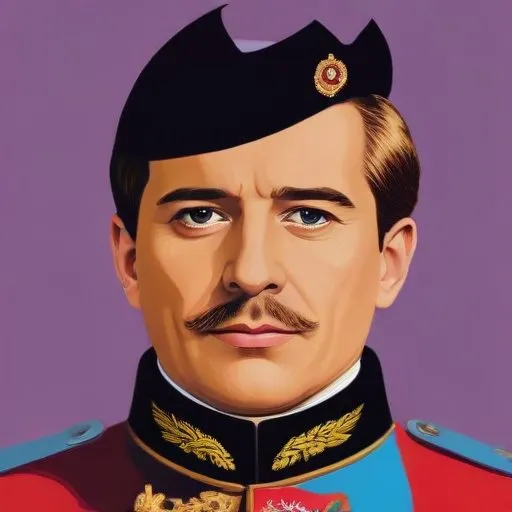
Emperor of Austria from 1835 to 1848, known for his role in the Revolutions of 1848 and his abdication in favor of his nephew Franz Joseph.
Ferdinand I of Austria, also known as Ferdinand V of Hungary, Croatia, and Bohemia, was the Emperor of Austria from March 1835 until his abdication in December 1848. He is remembered for his well-intentioned but passive nature, earning him the sobriquet "The Benign German" or "The Benevolent" in Czech and Polish respectively.
Ferdinand was born on April 19, 1793, to Francis II, Holy Roman Emperor and Maria Theresa of Naples and Sicily. Due to his parents' genetic closeness, Ferdinand suffered from hydrocephalus, neurological problems, and a speech impediment. Despite these challenges, he received a suitable education under the guidance of Baron Josef Kalasanz von Erberg and his wife Countess Josephine von Attems.
Ferdinand succeeded his father Francis I upon his death on March 2, 1835. However, due to his severe epilepsy, he was incapable of ruling the empire effectively. His father, before his death, had made a will that Ferdinand should consult his uncle Archduke Louis on all aspects of internal policy and be influenced by Prince Metternich, Austria's Foreign Minister. Following the Revolutions of 1848, Ferdinand abdicated on December 2, 1848, and was succeeded by his nephew, Franz Joseph.
Ferdinand married Maria Anna of Savoy, the sixth child of Victor Emmanuel I of Sardinia, but they had no children. After his abdication, he lived in Hradany Palace, Prague, until his death on June 29, 1875.
Ferdinand's reign was marked by his inability to effectively rule the empire due to his severe epilepsy. Despite this, he kept a coherent and legible diary and was said to have had a sharp wit. His abdication led to the rise of Franz Joseph, who would go on to rule Austria for nearly seven decades. Ferdinand's legacy is one of a well-intentioned but ultimately ineffective ruler, whose reign was marked by the decline of the Austrian Empire.
Although Ferdinand did not leave behind any notable quotes or sayings, his diary entries reveal a keen observer of the world around him. His writings provide valuable insights into the workings of the Austrian Empire during a tumultuous period.
Ferdinand's reign can be compared to that of his contemporaries, such as Frederick William IV of Prussia and Louis Philippe of France. Like Ferdinand, they faced similar challenges in maintaining power and stability in the face of rising nationalism and liberal movements. However, while Ferdinand's abdication was seen as a sign of weakness, Frederick William IV and Louis Philippe were able to maintain power, albeit through more authoritarian means.
Ferdinand's legacy has had a lasting impact on modern society. His abdication paved the way for the rise of Franz Joseph, who would go on to shape Austrian politics for generations to come. Additionally, Ferdinand's reign marked the beginning of the end of the Austrian Empire's dominance in Europe, paving the way for the rise of new powers and the eventual reordering of the continent.
Ferdinand I of Austria, despite his well-intentioned nature, was ultimately unable to effectively rule the empire due to his severe epilepsy. His legacy is one of a transitional figure, marking the beginning of the end of the Austrian Empire's dominance in Europe. Despite this, Ferdinand remains an important figure in Austrian history, and his story continues to fascinate and educate us to this day.
Born in 1830
The longest-reigning ruler of Austria-Hungary, presiding over a vast empire that spanned across Central Europe, and remembered for his role in shaping European history through diplomacy and war.
47 Years Old
R&B singer behind the iconic 1999 hit "Thong Song" and a founding member of the group Dru Hill, known for his smooth vocals and catchy hooks.
Born in 1832
The Archduke of Austria who was installed as the Emperor of Mexico, sparking a civil war, and is remembered for his liberal reforms and tragic fate.
Born in 1820
Unified Italy's first king, who played a key role in the country's unification and modernization. He's remembered for his strong leadership and diplomatic skills.
Born in 1815
Unified Germany's founder, a master strategist who forged a nation through diplomacy and war, leaving a lasting legacy in European politics.
