


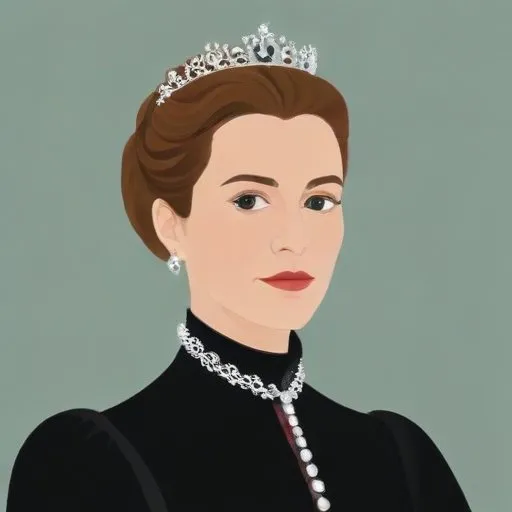
Daughter of Emperor Maximilian II, she played a crucial role in European politics through her marriages, becoming Queen of Spain and Portugal, and influencing the fate of the Habsburg dynasty. Her strategic alliances shaped the course of European history.
Archduchess Anna of Austria is renowned for her significant contributions to the cultural and artistic landscape of 16th-century Bavaria. As the Duchess of Bavaria from 1550 to 1579, she played a vital role in elevating the reputation of Munich as a city of art, fostering a cultural Renaissance that continues to influence the region to this day.
Born on July 7, 1528, at the Bohemian court in Prague, Anna was the third of fifteen children of King Ferdinand I and Anna of Bohemia and Hungary. Her paternal grandparents were King Philip I of Castile and Queen Joanna of Castile, while her maternal grandparents were King Vladislaus II of Bohemia and Hungary and Anne of Foix-Candale. This illustrious lineage set the stage for Anna's future prominence in European royal circles.
Young Anna was engaged several times as a child, first to Prince Theodor of Bavaria, and then to Charles d'Orlans. However, both of these early betrothals ended with the untimely deaths of her fiancés. It wasn't until she married Prince Albert V, the younger brother of her first fiancé, on July 4, 1546, that Anna finally secured her place as a duchess.
Upon becoming Duchess of Bavaria, Anna and her husband Albert V resided at the Trausnitz Castle in Landshut. They later moved to the Munich Residenz, where they wielded significant influence over the spiritual and cultural life of the duchy. Together, they founded several museums and laid the foundations for Munich's reputation as a city of art.
Beyond her cultural achievements, Anna was a devout Catholic and dedicated herself to various charitable pursuits. She was particularly devoted to the welfare of the poor and the sick, often providing financial support to institutions and organizations that shared her values.
Archduchess Anna of Austria's lasting impact on Bavarian culture and society is a testament to her vision, dedication, and patronage. Her legacy continues to inspire generations, serving as a beacon of enlightenment and cultural refinement. As a member of the Imperial House of Habsburg, Anna's influence extended beyond the borders of Bavaria, shaping the course of European history in subtle yet profound ways.
Born in 1635
The Queen of Spain who ruled as regent for her son Charles II, implementing reforms and centralizing power, while also being a patron of the arts.
Born in 1747
The last Habsburg ruler to hold the title of Holy Roman Emperor, he oversaw the dissolution of the empire and played a key role in European politics during the French Revolution.
Born in 1578
A devout Catholic who imposed religious uniformity, sparking the Thirty Years' War, and a strong advocate for the Counter-Reformation.
Born in 1717
The wife of Francis I, Holy Roman Emperor, ruled Austria and its territories with intelligence and diplomacy, implementing reforms and expanding the empire through strategic marriages. She's remembered for her strong leadership and cultural achievements.
Born in 1710
The monarch who ruled France from 1715 to 1774, known as the "Sun King's" great-grandson, and remembered for his extravagance, absolutism, and the decline of the French monarchy.
Born in 1716
The Enlightened Despot who reformed Spain, promoting education, arts, and economic growth, and is credited with modernizing Madrid.
