


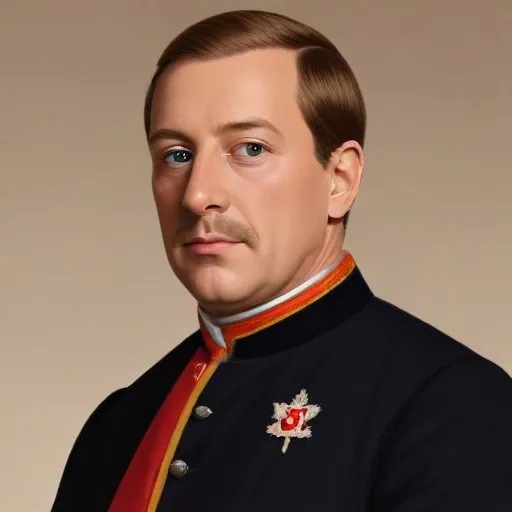
Governor of the Low Countries, overseeing the region's politics and economy during the Dutch Revolt, while also being a key figure in the Habsburg dynasty. He's known for his diplomatic efforts to maintain peace and unity in the region.
Archduke Albert VII of Austria is best known for his brief yet tumultuous reign as the ruling Archduke of Austria in 1619, as well as his joint sovereignty of the Habsburg Netherlands with his wife, Isabella Clara Eugenia, from 1598 to 1621. A man of many titles and roles, Albert VII's life was marked by his quest for power, his devotion to the Catholic Church, and his struggles to balance his secular and spiritual ambitions.
Born on November 13, 1559, Albert VII was the fifth son of Maximilian II, Holy Roman Emperor, and Maria of Spain. At the tender age of eleven, he was sent to the Spanish Court, where his uncle, King Philip II, oversaw his education. It was during this period that Albert developed a strong affinity for the Catholic Church, which would shape his future decisions and actions.
Albert's ecclesiastical career began in 1577, when he was appointed cardinal by Pope Gregory XIII, a position he held until 1598. During this time, he served as the Archbishop of Toledo, Viceroy of Portugal, and Governor General of the Habsburg Netherlands. His experiences in these roles prepared him for his future reign as Archduke of Austria.
In 1619, Albert VII succeeded his brother Matthias as the reigning Archduke of Lower and Upper Austria. However, his reign was short-lived, lasting only a few months before he abdicated in favor of Ferdinand II. This decision marked the end of his secular ambitions, allowing him to focus on his spiritual pursuits.
Albert VII's devotion to the Catholic Church remained unwavering throughout his life. His clerical upbringing had a lasting impact on his lifestyle, and he continued to serve the Church in various capacities. His legacy as a spiritual leader and statesman has endured, despite the brevity of his reign as Archduke.
Albert VII's life and legacy serve as a testament to the complexities of balancing secular and spiritual ambitions. His experiences as a statesman and religious leader offer valuable insights into the workings of European politics and the Catholic Church during the 16th and 17th centuries.
Despite the brevity of his reign, Albert VII's impact on Austrian and European history is undeniable. His story serves as a reminder of the intricate dance between power, politics, and faith that has shaped the course of human history.
Born in 1500
Ruling over a vast empire from 1519 to 1556, he was a powerful and influential leader who played a crucial role in shaping European politics and religion. He is most known for his efforts to unify Christian Europe and defend it against the Ottoman Empire.
Born in 1503
The first Habsburg to rule the Holy Roman Empire, he unified Austria and introduced the concept of a hereditary monarchy, shaping European politics for centuries to come.
Born in 1459
First Holy Roman Emperor to rule simultaneously as King of the Romans and King of Spain, known for uniting fragmented German states and establishing the Habsburg dynasty.
Born in 1503
The first Habsburg to rule the Holy Roman Empire, he unified Austria and introduced the concept of a hereditary monarchy, shaping European politics for centuries to come.
Born in 1586
Ruler of Austria and Styria from 1619 to 1632, known for his military campaigns against the Ottoman Empire and his role in the Thirty Years' War.
Born in 1578
A devout Catholic who imposed religious uniformity, sparking the Thirty Years' War, and a strong advocate for the Counter-Reformation.
