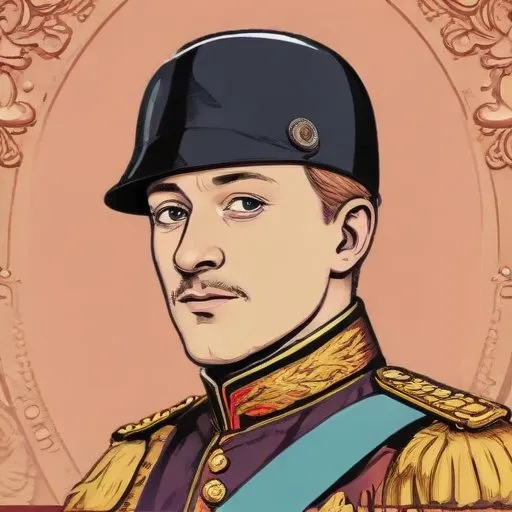
Leopold V, Archduke of Austria: The Ecclesiastical Leader Turned Ruler
A Life of Dual Ambition
Leopold V, Archduke of Austria, is renowned for his distinctive career path, which saw him traverse the realms of both the church and state. Born on October 9, 1586, in Graz, Leopold was invested as a bishop at a tender age of 12, marking the beginning of his ecclesiastical journey. His early involvement in the church would ultimately pave the way for his later rise to power as the ruler of Further Austria, including Tyrol.
Rise to Ecclesiastical Prominence
Leopold's meteoric rise in the church hierarchy began with his appointment as Prince-Bishop of Passau in 1598. Nine years later, in 1607, he became the Prince-Bishop of Strasbourg, a position he held until 1626. During this period, Leopold's influence extended beyond the ecclesiastical realm, as he actively participated in the War of the Jülich succession and the Brothers' Quarrel within the Austrian Habsburg dynasty.
Financier and Patron of the Arts
In 1614, Leopold financed the construction of the Church of the Jesuit College of Molsheim, a testament to his commitment to the arts and education. His coat of arms is still prominently displayed within the church, a lasting legacy of his patronage.
Ruler of Further Austria and Tyrol
Following the death of his kinsman and former rival,
Maximilian III, Archduke of Further Austria, Leopold inherited the governance of Further Austria and Tyrol in 1619. He resigned from his ecclesiastical positions in 1626 and married Claudia de Medici, marking the beginning of a new phase in his life as a ruler. During his tenure as Archduke of Further Austria, Leopold oversaw the construction of significant buildings, including the custom house and the Jesuit church in Innsbruck.
Defense of Tyrol and the Veltlin
Leopold's military prowess was showcased in his defense of Tyrol against the Swedish invasion in 1632. He also fought to secure the Veltlin, a region of strategic importance, demonstrating his prowess as a military leader.
Family and Legacy
Leopold's marriage to Claudia de Medici resulted in the birth of five children, who would go on to play significant roles in the Habsburg dynasty. His children included Maria Eleonora, Ferdinand Charles, Isabella Clara, Sigismund Francis, and Maria Leopoldine. Through his descendants, Leopold's legacy would persist until 1665, shaping the course of Austrian and European history.
Death and Burial
Leopold V, Archduke of Austria, passed away on September 13, 1632, in Schwaz, Tyrol. His death marked the end of an era, as he was laid to rest, his legacy as a leader, patron, and ruler cemented in the annals of history.
- Key Dates:
- October 9, 1586: Leopold V was born in Graz.
- 1598: Leopold was invested as a bishop.
- 1607: Leopold became the Prince-Bishop of Strasbourg.
- 1614: Leopold financed the construction of the Church of the Jesuit College of Molsheim.
- 1619: Leopold inherited the governance of Further Austria and Tyrol.
- 1626: Leopold resigned from his ecclesiastical positions and married Claudia de Medici.
- 1632: Leopold defended Tyrol against the Swedish invasion and fought for the Veltlin.
- September 13, 1632: Leopold V, Archduke of Austria, passed away in Schwaz, Tyrol.
FAQ
What was Leopold V, Archduke of Austrias role in Austrian history?
Leopold V, Archduke of Austria was a member of the House of Habsburg and played a key role in Austrian history, including his role as Duke of Styria and Archduke of Austria.
What were Leopold V, Archduke of Austrias notable achievements?
Leopold V, Archduke of Austrias notable achievements include his military campaigns against the Ottoman Empire and his role in establishing the Duchy of Styria as a major power in the region.
How did Leopold V, Archduke of Austrias reign impact the Austrian economy?
Leopold V, Archduke of Austrias reign saw significant economic growth, driven by his policies promoting trade, commerce, and agriculture.
What was Leopold V, Archduke of Austrias relationship like with the Holy Roman Empire?
Leopold V, Archduke of Austria had a close relationship with the Holy Roman Empire, which played an important role in Austrian politics and economy during his reign.
How is Leopold V, Archduke of Austria remembered in Austrian history?
Leopold V, Archduke of Austria is remembered as a capable and ambitious ruler who played a significant role in shaping Austrian history and establishing the Habsburg dynasty as a major power in Europe.