


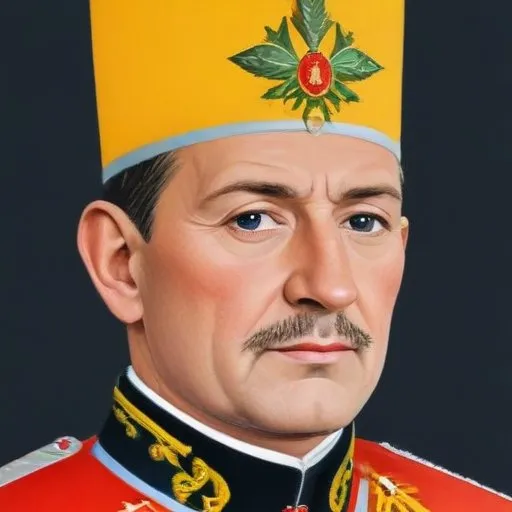
The last king of the Polish-Lithuanian Commonwealth, who ruled from 1764 to 1795 and is remembered for his attempts to reform and strengthen the state, but ultimately failed to prevent its partitioning.
Stanisław August Poniatowski, also known as Stanisław II Augustus, is remembered as the last monarch of the Polish-Lithuanian Commonwealth, ruling from 1764 to 1795. This tumultuous period saw the once-mighty Commonwealth dwindle and eventually disappear, marking the end of an era in Polish history.
Born into a wealthy Polish aristocratic family on January 17, 1732, Stanisław Antoni Poniatowski arrived at the Russian imperial court in Saint Petersburg in 1755 as a young diplomat. It was here that he caught the eye of the future Empress Catherine the Great, with whom he would have a long-lasting and intimate relationship.
With Catherine's aid, Poniatowski was elected King of Poland and Grand Duke of Lithuania by the Sejm (Polish parliament) in September 1764, following the death of Augustus III.
Contrary to expectations, Poniatowski attempted to reform and strengthen the large but ailing Commonwealth. He introduced a series of reforms aimed at modernizing the country, including the establishment of a national bank, the creation of a permanent army, and the promotion of education and Enlightenment values.
However, his efforts were met with fierce resistance from neighboring powers, including Prussia, Russia, and Austria, who were committed to keeping the Commonwealth weak. Internal opposition also came from conservative interests, who saw the reforms as a threat to their traditional liberties and privileges.
The defining crisis of his early reign was the War of the Bar Confederation (1768-1772), which led to the First Partition of Poland in 1772. This was followed by the Diet of 1788-1792, which introduced further reforms, including the Constitution of 3 May 1791.
However, these reforms were short-lived, as the 1792 Targowica Confederation and the Polish-Russian War of 1792 led to the Second Partition of Poland in 1793. The final blow came with the Third Partition of Poland in 1795, marking the end of the Commonwealth.
Stripped of all meaningful power, Poniatowski abdicated in November 1795 and spent the last years of his life as a captive in Saint Petersburg's Marble Palace, where he died on February 12, 1798.
Stanisław August Poniatowski remains a controversial figure in Polish history, viewed by some as a brave and skillful statesman, and by others as an overly hesitant coward, or even a traitor. His legacy is complex and multifaceted, reflecting the turbulent times in which he lived.
Poniatowski was an advocate for Enlightenment values, including the promotion of education, reason, and individual liberties. He believed in the importance of modernizing and strengthening the Polish-Lithuanian Commonwealth, and worked tirelessly to achieve this goal.
Stanisław August Poniatowski's legacy continues to shape Polish history and identity, with many viewing him as a symbol of national resilience and determination. His reforms and efforts to modernize the Commonwealth paved the way for future generations of Polish leaders and reformers.
Born in 1729
Empress of Russia from 1762 to 1796, she transformed her country into a major European power, modernizing its culture, politics, and economy through numerous reforms and conquests.
Born in 1769
A French military leader who rose to prominence during the French Revolution and became Emperor of France, known for his military conquests and reorganization of Europe. He is also famous for his Napoleonic Code, which remains a foundation of modern law.
Born in 1712
Prussian king who ruled with Enlightenment values, promoting arts, education, and religious tolerance, while also being a skilled military strategist and expanding his kingdom through wars.
Born in 1717
The wife of Francis I, Holy Roman Emperor, ruled Austria and its territories with intelligence and diplomacy, implementing reforms and expanding the empire through strategic marriages. She's remembered for her strong leadership and cultural achievements.
Born in 1741
Reformer of the Habsburg dominions, abolishing serfdom and promoting religious tolerance, who implemented numerous reforms to modernize his empire.
