


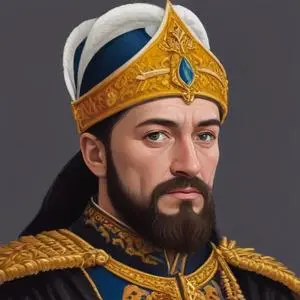
Led a successful Cossack uprising against Polish rule, establishing Ukraine as a sovereign state and paving the way for its modern independence.
Bohdan Khmelnytsky is renowned for leading an uprising against the Polish-Lithuanian Commonwealth and creating an independent Cossack state in Ukraine, subsequently allying with the Russian Tsar and placing central Ukraine under Russian protection. As Hetman of the Zaporozhian Host, he played a pivotal role in Ukrainian history, leaving a lasting legacy that still resonates today.
Although the exact date of Khmelnytsky's birth is unknown, historians suggest it was likely around December 27, 1595, or November 9, 1595. Born into Ukrainian lesser nobility, his father, Mykhailo Khmelnytsky, was a courtier of Great Crown Hetman Stanisaw kiewski.
Khmelnytsky's military prowess and natural leadership skills eventually led to his appointment as Hetman of the Zaporozhian Host, a position that granted him significant influence and authority. He capitalized on this power to mobilize the Cossacks, sparking the Khmelnytsky Uprising (1648-1654) against the Polish-Lithuanian Commonwealth and its magnates.
In 1654, Khmelnytsky concluded the Treaty of Pereiaslav with the Russian Tsar, forging an alliance between the Cossack Hetmanate and the Tsardom of Russia. This pact not only secured central Ukraine's protection under Russian rule but also had far-reaching consequences, including the massacre of thousands of Poles and Jews during 1648-1649, an event that would leave an indelible mark on Ukrainian nationalism and Jewish-Ukrainian relations.
Bohdan Khmelnytsky's legacy extends far beyond his military conquests. He played a crucial role in shaping Ukraine's identity, fostering Ukrainian nationalism, and paving the way for Ukraine's eventual independence. His Treaty of Pereiaslav marked a significant turning point in Ukrainian-Russian relations, setting the stage for centuries of complex diplomatic and cultural exchange.
In conclusion, Bohdan Khmelnytsky's remarkable life and achievements have left an indelible mark on Ukrainian history, cementing his status as a national hero and a symbol of Ukrainian identity.
60 Years Old
A Ukrainian billionaire and politician who served as the President of Ukraine from 2014 to 2019, known for his efforts to integrate Ukraine with the European Union and his role in the Ukrainian crisis.
Born in 1672
Reformed Russia's government, military, and culture, transforming it into a major European power. Known for modernizing and westernizing the country through numerous reforms and founding St. Petersburg.
Born in 1729
Empress of Russia from 1762 to 1796, she transformed her country into a major European power, modernizing its culture, politics, and economy through numerous reforms and conquests.
Born in 1856
A Ukrainian literary icon, celebrated for his poetry and novels that explored themes of social justice, Ukrainian identity, and folk culture. His works are considered a cornerstone of Ukrainian literature.
Born in 1814
Ukraine's national poet and playwright, celebrated for his powerful writings that inspired a national awakening and struggle for independence, with works still widely read and performed today.
