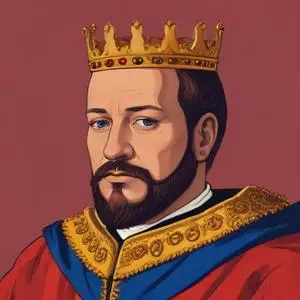
Gustavus Adolphus of Sweden: The Lion of the North
A Military Genius and a Nation's Savior
Gustavus Adolphus, also known as Gustav II Adolf, is renowned for being one of the most influential military minds in history, and the savior of Sweden during the Thirty Years' War. He is credited with transforming the Swedish army into a modern fighting force, and his military tactics and strategies are still studied by military historians and strategists today.
The Early Years
Born on December 9, 1594, in Stockholm, Sweden, Gustavus Adolphus was the eldest son of King
Charles IX and
Christina of Holstein-Gottorp. From a young age, he was groomed for greatness, receiving a rigorous education in languages, mathematics, and the sciences. His early years were marked by a strong sense of curiosity and a passion for learning, traits that would serve him well in his future military campaigns.
Rise to Power
In 1611, at the tender age of 17, Gustavus Adolphus became King of Sweden, following the death of his father. Initially, he faced opposition from the Swedish nobility, but he soon proved himself to be a shrewd and capable leader. He reformed the Swedish government, established a new code of laws, and strengthened the country's economy.
Military Reforms and Innovations
Gustavus Adolphus is perhaps best known for his groundbreaking military reforms. He introduced the concept of "combined arms" warfare, where infantry, cavalry, and artillery worked together to achieve a common goal. He also developed the "pike square" formation, which allowed his infantry to withstand cavalry charges. Additionally, he improved the mobility and firepower of his army by introducing lighter and more maneuverable artillery pieces.
The Thirty Years' War
In 1630, Gustavus Adolphus entered the Thirty Years' War on the side of the Protestant states, determined to counter the growing power of the Catholic Habsburgs. His military campaigns were marked by a series of stunning victories, including the Battle of Breitenfeld in 1631 and the Battle of Lützen in 1632. Although he was killed in the latter battle, his legacy continued to shape the course of the war.
Legacy and Impact
Gustavus Adolphus's military innovations and campaigns had far-reaching consequences. He is credited with creating the modern concept of a "national army," where soldiers were recruited from across the country, rather than relying on mercenaries. His emphasis on discipline, training, and logistics raised the standards of military professionalism. Furthermore, his support for the Protestant cause helped to cement Sweden's position as a major power in Europe.
Personal Milestones and Key Life Events
- 1613: Gustavus Adolphus marries Maria Eleonora of Brandenburg, cementing an alliance with a powerful German state.
- 1620: He launches a successful campaign against Poland, capturing the city of Riga.
- 1630: He enters the Thirty Years' War, determined to support the Protestant cause.
- 1632: He is killed in the Battle of Lützen, but his legacy continues to shape the war.
Quotes and Memorable Sayings
- "I am not a king, I am a warrior."
- "The bullet is a foolish thing, but it is a wise man who knows when to dodge it."
Historical Context and Legacy
Gustavus Adolphus lived during a time of great turmoil and upheaval in Europe. His military reforms and campaigns had a profound impact on the course of the Thirty Years' War, and his legacy continued to shape the development of modern warfare. Today, he is remembered as one of the greatest military minds in history, and his name is synonymous with bravery, strategic genius, and national pride.
FAQ
What were the military achievements of Gustavus Adolphus of Sweden?
Gustavus Adolphus of Sweden was a skilled military leader who introduced several innovative tactics, including the use of light cavalry and mobile artillery. He won several key battles, including the Battle of Breitenfeld and the Battle of Lützen, and is considered one of the most important military minds of the Thirty Years War.
What was the significance of Gustavus Adolphus in the Thirty Years War?
Gustavus Adolphus played a crucial role in the Thirty Years War, leading the Swedish army to several victories and helping to turn the tide of the war against the Holy Roman Empire. His military campaigns also helped to spread Protestantism in Europe.
What were the key reforms of Gustavus Adolphus of Sweden?
Gustavus Adolphus implemented several key reforms in Sweden, including the creation of a modernized bureaucracy, a strengthened military, and a more efficient taxation system. He also promoted education and the arts, and established the University of Uppsala.
How did Gustavus Adolphus of Sweden die?
Gustavus Adolphus died on November 6, 1632, at the Battle of Lützen, where he was shot and killed while leading a cavalry charge.
What is Gustavus Adolphus of Sweden remembered for?
Gustavus Adolphus is remembered as a brilliant military strategist, a champion of Protestantism, and a strong leader who modernized Sweden and promoted education and the arts. He is often referred to as the Father of Modern Warfare and is considered one of the most important figures of the Thirty Years War.