


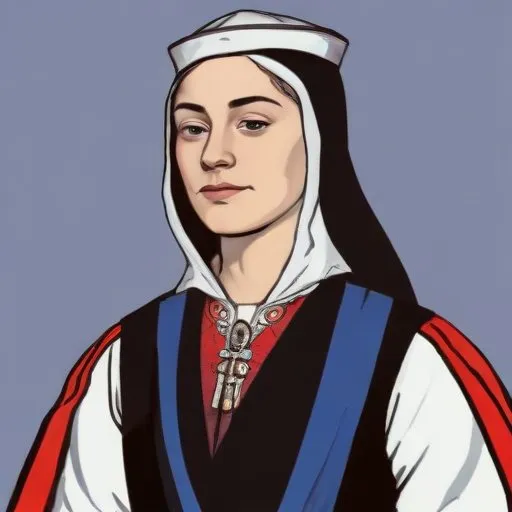
Queen of Sweden from 1620 to 1632, known for her strong personality, cultural achievements, and influential role in Swedish politics during the Thirty Years' War.
Maria Eleonora of Brandenburg, born on November 11, 1599, was the Queen of Sweden from 1620 to 1632, renowned for her marriage to King Gustav II Adolph, also known as Gustavus Adolphus. As the wife of one of the most powerful monarchs in Swedish history, Maria Eleonora played a significant role in shaping the country's destiny during a tumultuous period.
Born in Königsberg, Duchy of Prussia, Maria Eleonora was the third child and second daughter of John Sigismund, Elector of Brandenburg, and Duchess Anna of Prussia. Her upbringing was largely governed by her mother, who instilled in her the values of a noblewoman.
In 1616, Gustavus Adolphus of Sweden began searching for a Protestant bride, and his gaze fell upon the 17-year-old Maria Eleonora. Despite her father's initial reluctance, Gustavus Adolphus was smitten with Maria Eleonora's beauty and charm. Her father, however, was bedridden after an apoplectic stroke in 1617, leaving her mother to dictate the terms of the marriage.
In 1620, Maria Eleonora married Gustavus Adolphus, despite her brother George William's disapproval. The union bore a daughter, Christina, in 1626, who would later become the Queen of Sweden. Maria Eleonora's marriage marked the beginning of a new era in Swedish politics, as Gustavus Adolphus sought to expand Sweden's borders and consolidate his power.
Maria Eleonora's impact on modern society is palpable, as her marriage to Gustavus Adolphus paved the way for Sweden's transformation into a major European power. Her daughter Christina's ascension to the throne further solidified Maria Eleonora's legacy, as Christina went on to become one of the most influential monarchs in Swedish history.
Maria Eleonora's life and reign are set against the backdrop of the Thirty Years' War, one of the most devastating conflicts in European history. Her marriage to Gustavus Adolphus, a Protestant champion, played a crucial role in shaping the war's outcome. Maria Eleonora's legacy, however, extends beyond the realm of politics, as she embodied the qualities of a devoted wife, mother, and queen.
Maria Eleonora of Brandenburg's remarkable life serves as a testament to the complex and often tumultuous nature of royal politics. Her marriage to Gustavus Adolphus, her devotion to her daughter Christina, and her unwavering commitment to her role as queen have cemented her place in the annals of Swedish history.
Born in 1688
The King of Prussia who ruled with an iron fist, centralizing power and modernizing the state, while also being a patron of the arts and architecture. He's known for his military reforms and frugal lifestyle.
Born in 1687
The queen consort of Frederick William I, known as the mother of Frederick the Great, was a key figure in 18th-century Prussian politics and a patron of the arts. She's infamous for her unhappy marriage and subsequent imprisonment.
Born in 1657
King of Prussia from 1701 to 1713, crowned himself king, and established Berlin as his capital, transforming Prussia into a major power. He's known for his cultural and economic reforms.
Born in 1670
A powerful Polish king who transformed his country into a major European power through military conquests and cultural achievements, earning him the nickname "the Strong".
