


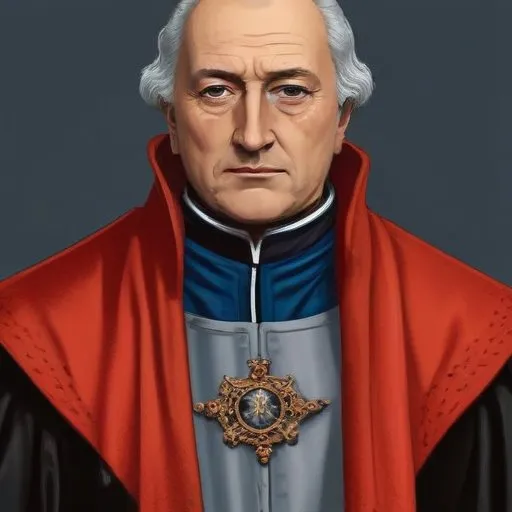
A 17th-century German ruler who united Protestant states and played a key role in the Thirty Years' War, known for his diplomatic and military skills. He strengthened the Hohenzollern dynasty, paving the way for Prussia's rise to power.
John Sigismund, Elector of Brandenburg, is renowned for his pivotal role in the formation of Brandenburg-Prussia, a powerful state that would shape the course of European history. Through his marriage to Duchess Anna of Prussia, he became the Duke of Prussia, uniting the two territories and laying the foundation for the Kingdom of Prussia.
Born on November 8, 1572, in Halle an der Saale, John Sigismund was the son of Joachim III Frederick, Elector of Brandenburg, and his first wife Catherine of Brandenburg-Küstrin. Upon his father's death in 1608, John Sigismund succeeded him as Margrave of Brandenburg.
In 1611, John Sigismund traveled to Warsaw, where he pledged feudal homage to Sigismund III Vasa, King of Poland, for the Duchy of Prussia, which was a Polish fief at the time. Shortly thereafter, Albert Frederick, Duke of Prussia, died without a direct male heir, and John Sigismund officially became the Duke of Prussia in 1618, having served as regent for several years prior.
One of John Sigismund's most significant actions was his conversion from Lutheranism to Calvinism. Although he had initially equalized the rights of Catholics and Protestants in the Duchy of Prussia under pressure from the King of Poland, he was eventually won over to Calvinism during a visit to Heidelberg in 1606. He publicly took communion according to the Calvinist rite on December 25, 1613, a move that would have far-reaching consequences for his subjects.
John Sigismund's reign was marked by several notable achievements, including the receipt of the territories of Cleves, Mark, and Ravensberg in the Treaty of Xanten in 1614, and his gift of the Reichshof Castrop to his teacher and educator, Carl Friedrich von Bordelius.
John Sigismund's marriage to Duchess Anna of Prussia, the eldest daughter of Duke Albert Frederick of Prussia, was a key factor in his rise to power. The couple's union resulted in the potential creation of Brandenburg-Prussia, which became a reality after Poland's leader appointed John Sigismund in charge of Prussia in regency.
John Sigismund suffered a stroke in 1616, from which he never recovered. He died on December 23, 1619, leaving behind a legacy that would shape the course of European history for centuries to come.
John Sigismund's unification of Brandenburg and Prussia created a powerful state that would go on to play a significant role in European politics. His conversion to Calvinism also had far-reaching consequences for his subjects and the region as a whole. Today, he is remembered as a key figure in the formation of the Kingdom of Prussia, which would eventually become a major power in Europe.
John Sigismund's life and legacy continue to fascinate historians and scholars today, serving as a testament to the complexities and intrigues of European politics in the early modern period.
Born in 1505
A 16th-century German ruler who oversaw the Protestant Reformation in Brandenburg and played a key role in the Schmalkaldic War. He's also known for his cultural achievements, including the establishment of the University of Vienna.
Born in 1484
A 16th-century German nobleman who ruled Brandenburg and played a key role in the Protestant Reformation, known for his diplomatic and military skills. He was a prominent figure in the early modern European politics.
Born in 1414
A powerful German prince who ruled Brandenburg from 1471 to 1486, known for his military campaigns and territorial expansions, earning him the nickname "Achilles" for his bravery.
Born in 1371
A 14th-century German nobleman who ruled Brandenburg and played a key role in the formation of the German Empire, known for his military conquests and territorial expansions.
Born in 1371
A 14th-century German nobleman who ruled Brandenburg and played a key role in the formation of the German Empire, known for his military conquests and territorial expansions.
