


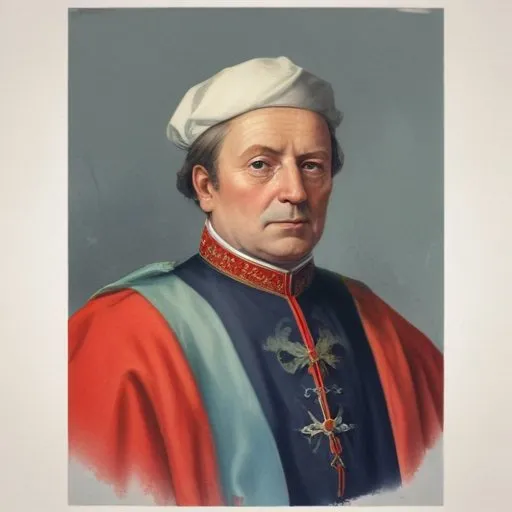
A 16th-century German nobleman who ruled Brandenburg and played a key role in the Protestant Reformation, known for his diplomatic and military skills. He was a prominent figure in the early modern European politics.
Joachim I Nestor, Elector of Brandenburg, was a prominent figure in 16th-century Europe, renowned for his administrative prowess and commitment to reform. As the fifth member of the House of Hohenzollern, he played a significant role in shaping the destiny of the Margraviate of Brandenburg, ruling from 1499 to 1535.
Born on February 21, 1484, Joachim was the eldest son of John Cicero, Elector of Brandenburg. Under the guidance of Dietrich von Blow, Bishop of Lebus and Chancellor of Frankfurt University, Joachim received an excellent education, laying the foundation for his future leadership.
Upon his father's death in January 1499, Joachim succeeded him as Elector of Brandenburg. Two years later, he married Elizabeth of Denmark, daughter of King John of Denmark, in 1502. This union produced five children, including Joachim II Hector, Anna, Elisabeth, Margaret, and John.
Joachim's leadership was marked by a series of reforms aimed at restoring order and promoting commerce in his electorate. He introduced stern measures to maintain law and order, improved the administration of justice, and supported the growth of trade and commerce. His sympathy towards the needs of the towns further endeared him to his subjects.
In the lead-up to the 1519 imperial election, Joachim's vote was highly sought after by King Francis I of France and Charles of Habsburg. After negotiating with both parties, Joachim ultimately voted for Charles, who went on to win the election. Although Joachim's decision was seen as a strategic move, his relationship with the Emperor remained strained in the following years.
Joachim I Nestor's legacy is marked by his commitment to reform and his efforts to promote commerce and justice in Brandenburg. While his diplomatic endeavors were often shrouded in controversy, his administrative reforms had a lasting impact on the region. His name has become synonymous with vision and leadership, earning him the nickname "Nestor," inspired by the wise King Nestor of Greek mythology.
Joachim's marriage to Elizabeth of Denmark produced five children, each of whom went on to play significant roles in European politics and history. His family life was marked by a strong sense of duty and responsibility, reflecting his commitment to the well-being of his electorate.
Joachim I Nestor, Elector of Brandenburg, passed away on July 11, 1535, leaving behind a legacy of reform and vision. His contributions to the development of Brandenburg continue to inspire generations, solidifying his place as one of the most notable figures of the 16th century.
Born in 1503
Elector of Saxony who played a key role in the Protestant Reformation and was a prominent leader of the Schmalkaldic League, a defensive alliance of Protestant states. He's also known for being captured and imprisoned by Emperor Charles V.
Born in 1504
A German nobleman who ruled Hesse from 1509 to 1567, known for being a champion of the Protestant Reformation and a key figure in the Schmalkaldic League.
Born in 1441
German ruler of Saxony who introduced the Reformation and played a key role in the early Protestant movement, shaping the course of European history.
Born in 1463
A key figure in the early Protestant Reformation, he protected and supported Martin Luther, providing a safe haven for him to translate the Bible into German. He's also known for his role in establishing the University of Wittenberg.
Born in 1525
A 16th-century German nobleman who ruled Brandenburg and played a key role in the Protestant Reformation, issuing the "Emphyteutic Lease" to protect his people's rights.
Born in 1505
A 16th-century German ruler who oversaw the Protestant Reformation in Brandenburg and played a key role in the Schmalkaldic War. He's also known for his cultural achievements, including the establishment of the University of Vienna.
Born in 1572
A 17th-century German ruler who united Protestant states and played a key role in the Thirty Years' War, known for his diplomatic and military skills. He strengthened the Hohenzollern dynasty, paving the way for Prussia's rise to power.
