


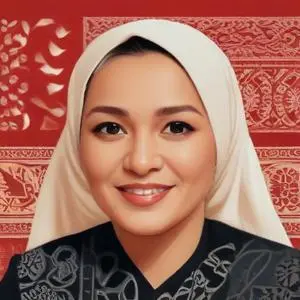
First female President of Indonesia, leading the country from 2001 to 2004 and playing a key role in its transition to democracy. She's a symbol of female empowerment in a predominantly Muslim country.
Megawati Sukarnoputri, the fifth president of Indonesia from 2001 to 2004, is a trailblazing figure in Indonesian politics and a testament to the country's strides towards democracy and gender equality. She holds the distinction of being the first and, to date, only female president of Indonesia, as well as the fifth woman to lead a Muslim-majority country.
Megawati Sukarnoputri was born on January 23, 1947, in Jakarta, Indonesia. Her name, Sukarnoputri, meaning "daughter of Sukarno," is a patronym, a nod to her father, Sukarno, Indonesia's first president. This familial connection laid the groundwork for Megawati's eventual entry into politics.
Megawati's political career began in the 1980s, when she became involved in the Indonesian Democratic Party (PDI). She quickly rose through the ranks, becoming the party's chairperson in 1993. In 1999, she was elected as the country's eighth vice president, serving under President Abdurrahman Wahid.
When Wahid was removed from office in 2001, Megawati took the reins, becoming Indonesia's first female president. During her tenure, she implemented significant reforms, including the establishment of the Corruption Eradication Commission and the introduction of a general election system that allowed for the direct election of the president and vice president.
Megawati's presidency marked a significant shift in Indonesia's political landscape. Her leadership paved the way for greater democratic participation and accountability, earning her the title "Mother of Upholding the Constitution." She also played a crucial role in promoting women's empowerment, inspiring a new generation of female politicians and leaders.
Today, Megawati remains a prominent figure in Indonesian politics, serving as the leader of the Indonesian Democratic Party of Struggle (PDIP), one of the country's largest political parties. Her dedication to democracy, justice, and equality continues to shape Indonesia's political discourse.
Megawati's political philosophy is rooted in her commitment to democracy, justice, and equality. She has consistently advocated for the empowerment of marginalized groups, particularly women and the poor. Her leadership style is characterized by a strong sense of determination, resilience, and compassion.
Megawati's impact on modern Indonesian society cannot be overstated. She has inspired a new generation of women to enter politics, breaking down barriers and challenging traditional gender norms. Her contributions to democratic reforms and anti-corruption efforts have helped shape Indonesia's political landscape.
As a pioneering female leader, Megawati has become an icon for women's empowerment, not only in Indonesia but globally. Her story serves as a testament to the power of determination, hard work, and perseverance in the face of adversity.
65 Years Old
The first Indonesian president from a lower-middle-class background, known for his efforts to boost economic growth and infrastructure development, while also promoting tolerance and pluralism.
77 Years Old
The first democratically elected President of Indonesia, serving from 2004 to 2014, known for maintaining stability and promoting economic growth during his tenure. He also played a key role in combating terrorism and separatist movements.
86 Years Old
A journalist and politician who served as the 4th President of Indonesia, known for promoting democracy and interfaith dialogue in a country with the world's largest Muslim population. He was a key figure in Indonesia's transition to democracy after decades of authoritarian rule.
Born in 1921
The authoritarian leader who ruled Indonesia for three decades, known for his iron-fisted governance and economic development, but also accused of human rights abuses and corruption.
86 Years Old
The 9th Vice President of Indonesia, a prominent journalist and politician, played a crucial role in shaping the country's political landscape during a tumultuous period. He's known for his efforts to promote democracy and human rights.
