


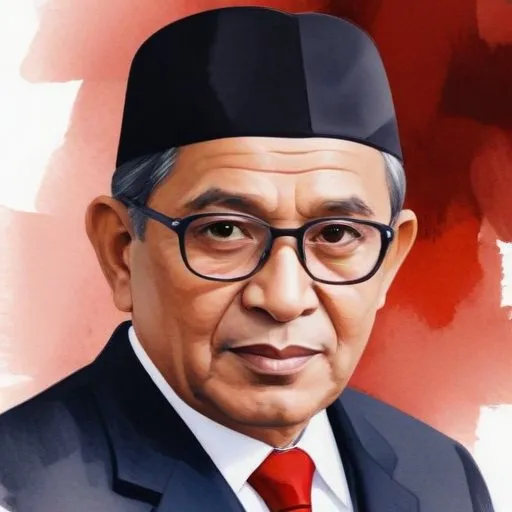
A journalist and politician who served as the 4th President of Indonesia, known for promoting democracy and interfaith dialogue in a country with the world's largest Muslim population. He was a key figure in Indonesia's transition to democracy after decades of authoritarian rule.
Abdurrahman Wahid, colloquially known as Gus Dur, was a beacon of hope for Indonesia's diverse population, serving as the country's fourth president from 1999 to 2001. He was a champion of pluralism, instrumental in lifting the ban on Chinese New Year celebrations and establishing Confucianism as the sixth official religion in Indonesia.
Born on September 7, 1940, in Jombang, East Java, Wahid was the son of Minister of Religious Affairs Wahid Hasyim and the grandson of Nahdlatul Ulama founder Hasyim Asyari. His family's rich legacy in Islamic leadership and education laid the foundation for his own path to greatness.
Wahid's leadership journey began within the Nahdlatul Ulama organization, where he rose through the ranks to become one of its most influential leaders. He later founded the National Awakening Party (PKB), which became a powerful force in Indonesian politics.
Wahid's dedication to promoting peace, tolerance, and human rights earned him numerous awards and honors, including the Magsaysay Award for Community Leadership in 1993 and the Ramon Magsaysay Award for Peace and International Understanding in 2000.
Wahid's personal life was marked by his unwavering commitment to his faith and his people. Despite his visual impairment, caused by glaucoma, he remained steadfast in his pursuit of justice and equality. He was affectionately known as Gus Dur, a nickname derived from the Javanese honorific "Gus" and the short form of his name, Abdurrahman.
Abdurrahman Wahid's legacy extends far beyond his presidency. He is remembered as a champion of pluralism, a defender of minority rights, and a beacon of hope for a more inclusive and tolerant Indonesia. His courageous stance against oppression and discrimination has inspired generations of Indonesians to strive for a more just and peaceful society.
"The essence of religion is to teach humans about justice, compassion, and love. Without these, religion is meaningless."
— Abdurrahman Wahid
Abdurrahman Wahid's unwavering dedication to the principles of justice, compassion, and love has left an indelible mark on Indonesian history. As a champion of pluralism and a defender of minority rights, his legacy continues to inspire generations to strive for a more inclusive and tolerant society.
79 Years Old
First female President of Indonesia, leading the country from 2001 to 2004 and playing a key role in its transition to democracy. She's a symbol of female empowerment in a predominantly Muslim country.
77 Years Old
The first democratically elected President of Indonesia, serving from 2004 to 2014, known for maintaining stability and promoting economic growth during his tenure. He also played a key role in combating terrorism and separatist movements.
65 Years Old
The first Indonesian president from a lower-middle-class background, known for his efforts to boost economic growth and infrastructure development, while also promoting tolerance and pluralism.
Born in 1912
The second Vice President of Indonesia, serving from 1973 to 1978, known for his efforts to maintain national unity and stability during a tumultuous period in Indonesian history. He played a key role in shaping the country's foreign policy and economic development.
79 Years Old
First female President of Indonesia, leading the country from 2001 to 2004 and playing a key role in its transition to democracy. She's a symbol of female empowerment in a predominantly Muslim country.
